30-Year U.S. Treasury Bonds Break 5%
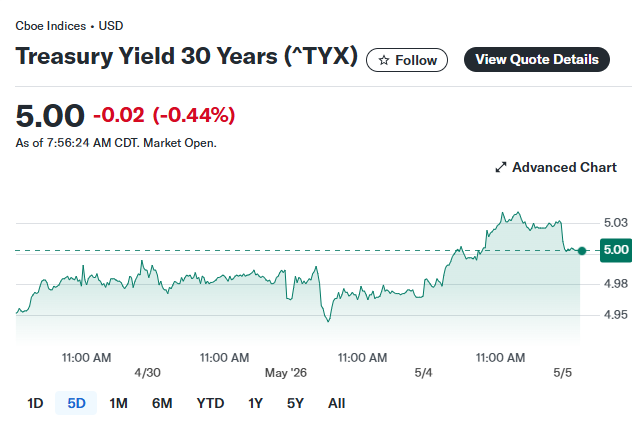
Since breaking through the critical level of 5% last July, the 30-year U.S. Treasury yield has once again surged past 5%, indicating that the U.S. market is once again gripped by serious concerns over debt pressure.
Traders are closely monitoring whether the yield could rise further. Over the past three years, the yield on 30-year U.S. Treasury bonds has approached or broken the 5% mark four times, with each occurrence leading to a short-term market shock, followed by a rebound as yields retreated.
In October 2023, due to investor expectations that the Federal Reserve would maintain its high-interest-rate policy for a longer period, a huge supply of U.S. Treasury bonds, and weak demand in auctions, the yield on 30-year Treasury bonds rose to 5.15%, followed by a roughly 6% decline in the S&P 500 index. It was not until later, when inflation data eased and the Federal Reserve's policy shift drove Treasury yields lower, that the stock market rebounded.
The direct cause of this rise in U.S. Treasury yields is related to the U.S.-Iran conflict, with the ceasefire agreement at risk of collapsing at any moment, and the market has already begun preparing for an oil price shock. In addition, ongoing U.S. inflation concerns, a massive supply of Treasury bonds, and the Federal Reserve leadership transition are also major contributing factors to the rise in U.S. Treasury yields.
If the 30-year Treasury yield continues to climb above 5%, the pressure may not be limited to the bond market but could spill over into real estate, small-cap stocks, high valuation growth stocks, and any other sectors reliant on long-term funds to maintain low costs.
Wall Street Interpretation
Vivek Paul, Global Head of Investment Portfolio Research at BlackRock Investment Institute, told the media that bond prices are repricing as the market anticipates interest rates will remain high for a longer period or there will be fewer rate cuts, which he considers a reasonable inference.
BlackRock Investment Institute has reduced its long positions in U.S. Treasury bonds, believing that energy shocks and existing headwinds will push up the term premium. The term premium refers to the additional yield demanded by investors for holding long-term bonds instead of rolling over a series of short-term bonds over the same period.
Henrietta Pacquement, Senior Portfolio Manager of Fixed Income at Allspring, noted that if energy supply disruptions were to worsen, such as damage to Middle Eastern oil infrastructure, yields could break through recent ranges. Additionally, U.S. AI-driven economic growth could lead to tighter policies from the Federal Reserve, thereby pushing up yields.
The unusual movement of U.S. Treasury yields has also made Wednesday's U.S. Treasury refinancing announcement a spotlight for the market. For over a year, the Treasury has stated in its announcements that it will maintain the scale of bond issuance "for at least the next few quarters," and Wall Street is now scrutinizing every word in that statement.
Jack McIntyre, Portfolio Manager at Brandywine asset management company, pointed out that if the phrasing changes from "for at least a few quarters" to "for a few quarters," the market would interpret it as the current issuance scale being maintained for approximately three more quarters.
Morgan Stanley strategist Martin Tobias and his team wrote in a report that the recent rise in yields supports the cautious stance of the U.S. Treasury in providing future guidance. The yield on the 10-year Treasury note has risen from 4.27% at the time of the last refinancing announcement to about 4.44%.
市场有风险,内容仅供研究参考,不构成投资建议。