AI Arms Race Burns Through Cash Flow, Tech Debt Bubble Emerges
After the five major hyperscale technology companies (Amazon, Google, Meta, Microsoft, Oracle) successively raised their capital expenditure plans in their first-quarter earnings reports, Morgan Stanley's Chief Cross-Asset Strategist Andrew Sheets immediately raised the combined capital expenditure forecast for the five companies to $800 billion in 2026, nearly doubling from 2025 and tripling from 2024; the forecast for 2027 further rises to over $1.1 trillion.

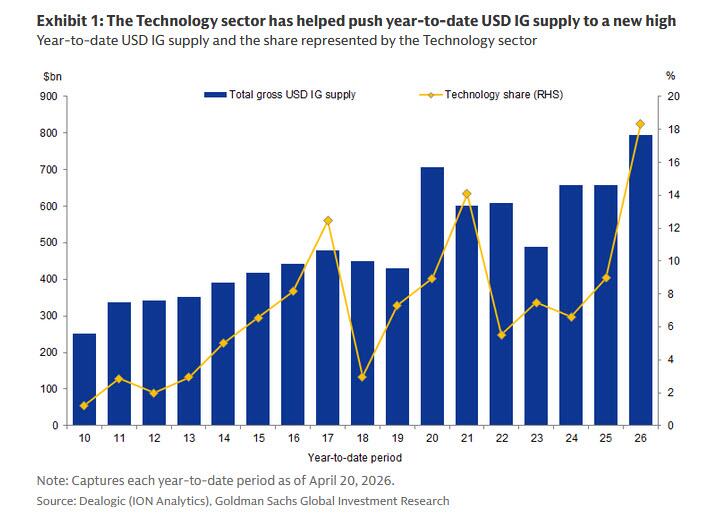
Where will the money come from? There is only one answer: borrowing. The free cash flow data of Amazon and Meta show that both companies have approached or fallen into the negative range. With the need to maintain stock buybacks and dividends, additional capital expenditures can only be supported by issuing debt. Morgan Stanley estimates that the total issuance volume of the U.S. investment-grade (IG) bond market in 2026 will be approximately $2.25 trillion, a year-on-year increase of 25%, with a net supply of about $1 trillion, a year-on-year increase of 57%, making it the busiest year on record. Gold Sachs' Chief Credit Strategist Amanda Lynam calculated that as of April 20, the issuance volume of U.S. IG bonds had reached $794 billion for the year, which is consistent with Morgan Stanley's forecast on an annualized basis, marking the strongest start ever. The technology sector has contributed 18% of the U.S. IG bond supply this year, the highest share ever, double that of the same period in 2025.
The fatigue in the bond market has quietly emerged. Meta issued up to $25 billion in investment-grade bonds last week, with a peak order book of about $96 billion, significantly reduced compared to the $120 billion demand for the same issuer's $30 billion bond last October. An issuer related to SoftBank Group had to increase the issuance yield due to insufficient demand; investors began to demand stronger protective terms, including asking Alphabet to provide a "backstop," which guarantees data center rent payments even if the tenants default; some investors directly rejected Oracle's $14 billion Michigan data center bonds, partly due to the inclusion of unfavorable redemption terms for creditors. PGIM Fixed Income Global Bond Head Robert Tipp said: "At the end of the day, these companies are selling a lot of debt, and they are going to have to pay a higher price to borrow money. After corporate spreads narrowed sharply to historical lows, the market is facing a wall of worry."
The pressure on the banking side is deeper. According to the Financial Times, major lending institutions such as JPMorgan Chase, Morgan Stanley, and Sumitomo Mitsui Banking Corporation (SMBC) are actively looking for ways to spread the risks associated with data center-related debts to a broader range of investors. Man Group's Co-Head of Credit Risk Sharing, Matthew Moniot, bluntly said: "The scale we are talking about is far beyond any previous imagination, and banks will soon be overwhelmed." A specific case: JPMorgan Chase and Mitsubishi UFJ (MUFG) spent over six months trying to distribute the $38 billion construction debt related to Oracle's data center projects in Texas and Wisconsin, ultimately having to sell part of it at a discount to non-bank institutions due to insufficient demand. Banks are exploring structured tools such as "Significant Risk Transfer" (SRT) to move the highest risk parts off their balance sheets.
Concentration risk is reshaping the structure of the IG market. Gold Sachs IG credit trader Jeffrey Papai pointed out that over the past year, among the 660 IG bond issuers, only 11 contributed about 25% of the duration-adjusted issuance volume, among which AI capital expenditure-related names (the four hyperscale technology companies plus four large data center financings) accounted for nearly 20% alone. Oracle is now the largest single name in the IG index in terms of risk-adjusted; Meta has jumped from the 51st position to the 8th position in less than a year. At the same time, Meta's credit default swaps (CDS) set a record for the
市场有风险,内容仅供研究参考,不构成投资建议。