Analysis: Taiwan and South Korea Becoming High-Beta Bets in AI Semiconductor Cycle, Signs of Crowded Trade Fracture Emerge
TS Lombard highlighted in its latest report that the AI craze is shaping Taiwan and South Korea into high leverage bets in the semiconductor cycle, with the chip industry's dominance over the trade accounts, economic growth, and stock markets of both countries far exceeding the norm.
The data speaks volumes. Semiconductors currently account for about 20% of Taiwan's GDP, with TSMC alone estimated to contribute around 9%, and the electronic components manufacturing industry driving an acceleration of growth to about 76% by 2025. The power consumption of the chip industry has reached about 25% of the island's total electricity usage. Taiwan's current account surplus is as high as 25% of GDP, South Korea's is about 18.2%, and Taiwan's GDP per capita (purchasing power parity) has surpassed that of the United States, with economic growth reaching 8%. TS Lombard直言, this combination "should not logically exist".
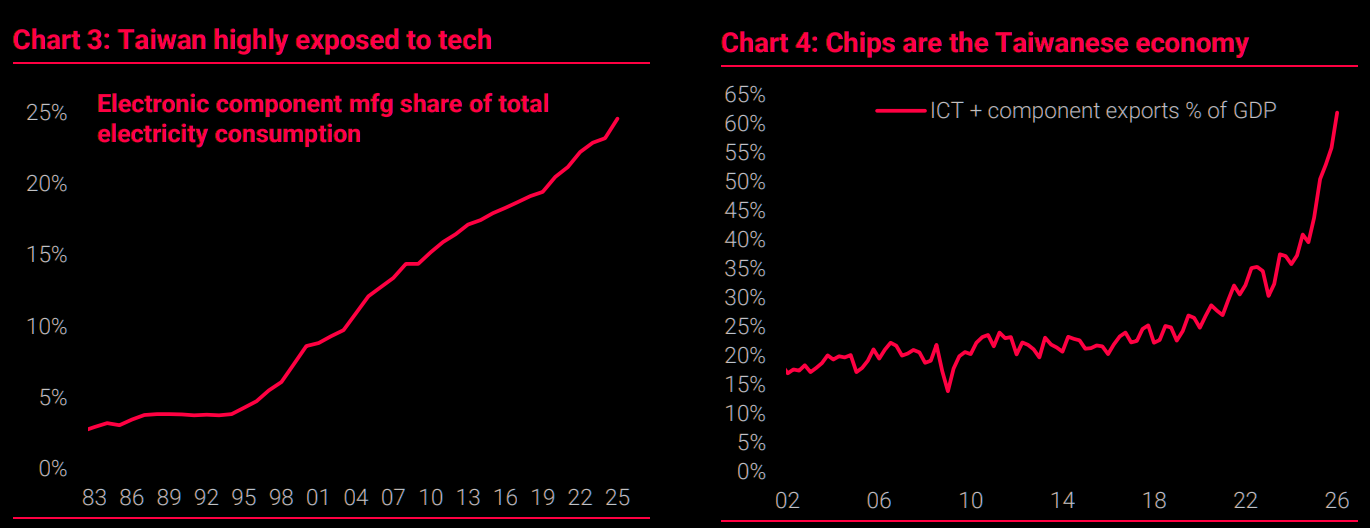
More concerningly, the oil price shock triggered by the current Iran war should theoretically severely damage the trade conditions of both countries, but the skyrocketing prices of memory chips and processors have completely offset this shock. The market is essentially viewing semiconductors as a more strategically prioritized asset than energy costs.
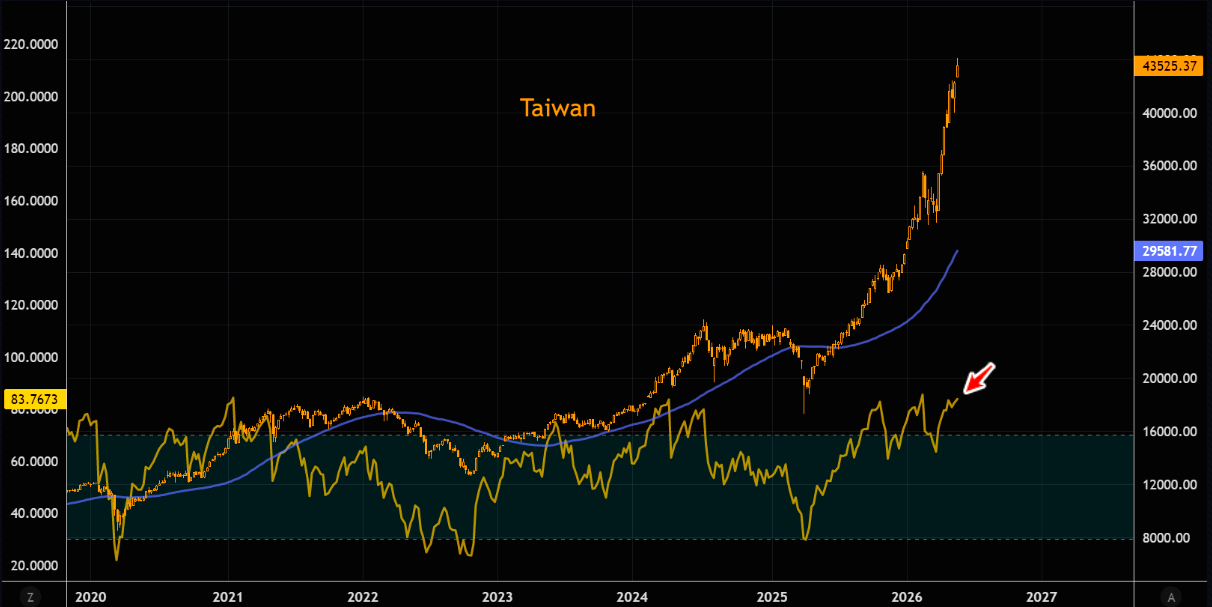
On the stock market front, Taiwan's stock market is increasingly resembling a parabolic AI proxy target, with the 50-week moving average significantly deviating, and the RSI entering a sensitive range. South Korea's composite stock price index has risen about 12% over the past four trading days, closing at a new historical high, but the divergence between the 50-day moving average and prices is also extremely stretched.
The divergence in capital flows is also striking. Foreign capital sales are accelerating, but South Korean retail investors are still aggressively chasing semiconductor stocks, with the flow divergence between institutions and retail investors becoming more extreme. South Korea's strong rebound in export data in May is regarded as one of the most important real-time indicators for observing the global semiconductor outlook.
For investors worried about the over-concentration of AI semiconductor sentiment, The Market Ear points out that EWY put spread options have begun to show the convex value of hedging semiconductor position risks, with the maximum odds of EWY's June 175/150 put spread being about 5 times.
市场有风险,内容仅供研究参考,不构成投资建议。