Bank of America Proposes Four Investment Themes in AI Infrastructure
The expansion of AI is consuming the world's most fundamental resources at a pace far beyond expectations. According to a research report released by Bank of America Securities (BofA Global Research) on April 21, by 2030, the annual electricity consumption of global data centers will exceed that of the entire country of Japan, and the annual water consumption will be equivalent to the total annual drinking water volume of New York City, with this construction wave expected to attract a cumulative investment of $7 trillion before 2030.
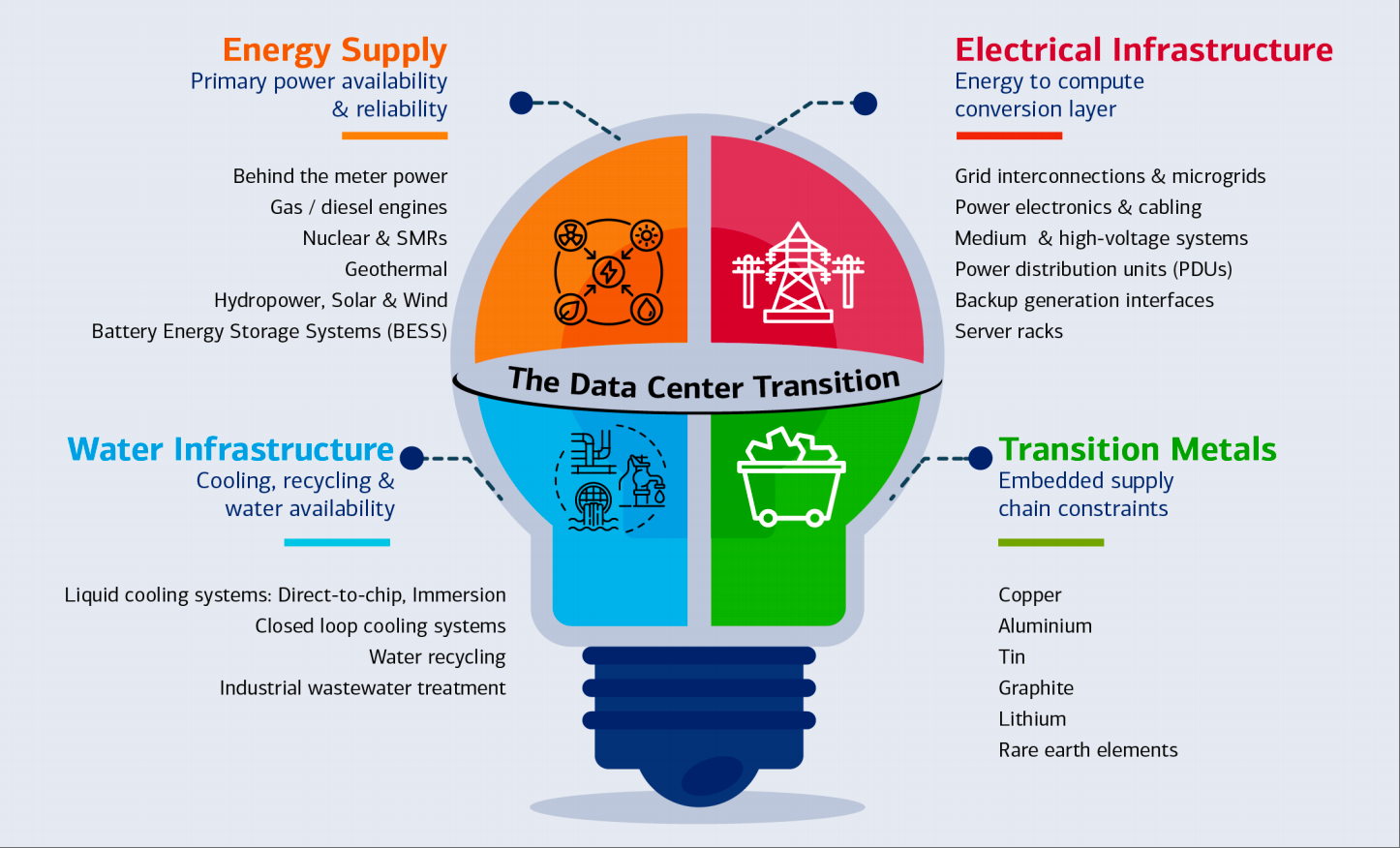
BofA has identified 67 globally rated "buy" related public companies in the report, spanning across four sectors: power supply, electrical equipment, cooling and water treatment, and strategic metals.
The Power Grid is Not Ready Yet
Data centers consumed 485 terawatt-hours of electricity in 2025, a year-on-year increase of 17%, with the electricity consumption growth rate for AI-specific facilities approaching 50%. BofA predicts that by 2030, data center electricity consumption will account for more than 3% of the global total demand, equivalent to the annual electricity consumption of the entire country of Japan.
The power consumption of GPU servers is growing at a rate of about 30% per year, and by 2027, the peak power consumption of a single AI server cabinet will be equivalent to that of 65 average households. Such a level of load is a structural shock for existing power grids, rather than a cyclical fluctuation.
Even more tricky is the mismatch in infrastructure timelines. High-voltage transmission projects in the United States and Europe typically take 7 to 10 years to complete approval, while the construction period for hyperscale data centers is only 2 to 3 years. The startup pace of power infrastructure is far behind the expansion pace of data centers.
Faced with this gap, technology giants are bypassing the power grid and solving the problem on their own. Amazon, Microsoft, Google, and Meta have captured 80% of the top ten global enterprise clean energy purchases, and are accelerating the lock-up of small modular nuclear reactors (SMR) — global SMR contracted capacity has soared from 25GW in 2024 to 45GW in 2025. Power supply is transforming from a public utility issue into a strategic asset for technology companies.
Water is the Most Underestimated
Content is for reference only, not financial advice.