ByteDance discreetly restarts smartphone R&D, recruitment clues puzzle together a complete blueprint
According to the latest exclusive report from BlockBeats, we have conducted a comprehensive analysis of ByteDance's official recruitment system, finding that ByteDance is not only developing AI applications on the client side but is also building an entire base of smartphone-level hardware and software. The recruitment clues range from the hardware supply chain, system base to the AI interaction layer, presenting a distinct flavor of a major full-range hardware company.
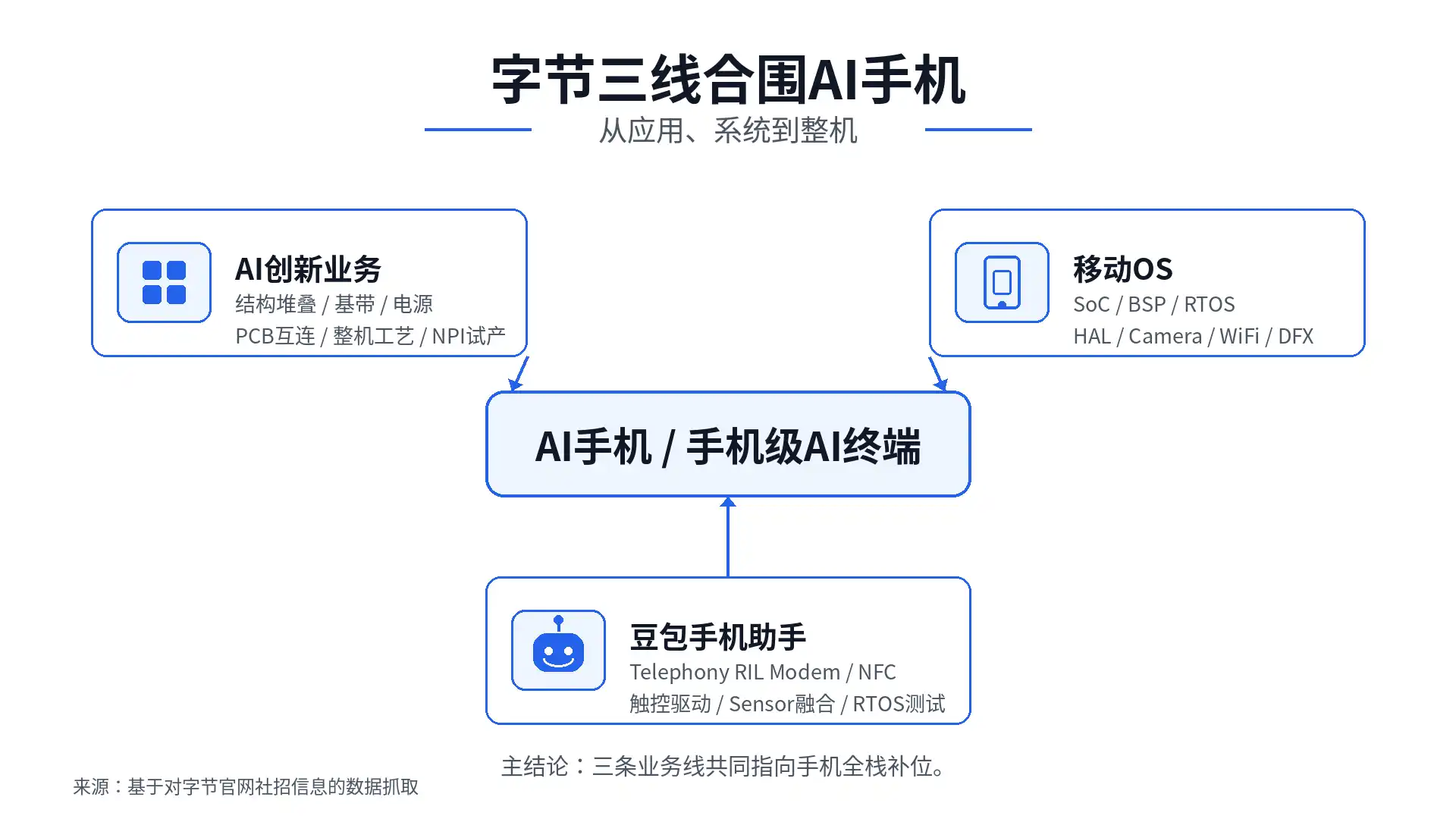
The hardware-side signals are the most direct. Shenzhen's development node densely releases positions related to whole machine processes, PCB high-speed interconnections, testing processes, and hardware baseband positions. The structural engineer position demands cover new machine stacking, frame, battery cover, and hinge design, and lists experience in foldable screens, LIPO packaging, and IP68/IP69K flagship machine development as a plus. The whole machine process positions require mastery of DFM/DFA/DFS analysis and NPI trial production introduction, which means ByteDance's R&D push has already penetrated to the trial production stage aligned with the contracted factory production line.
In terms of the system base, the Android system expert position in Beijing covers the entire process from project initiation, system solution, integrated development to mass production and delivery, involving ODM/OEM docking, Android Framework, HAL, and Qualcomm platform tuning, even controlling factory flashing and production line testing. The mobile OS team is also recruiting experts in SoC chip adaptation, BSP, RTOS kernel, WiFi drivers, and system power consumption, almost reconstructing the entire underlying system skeleton of a smartphone.
The most crucial breakthrough appears in the DouBao phone assistant team. The Telephony RIL Modem product architect recruited by this team is required to have experience in cellular network delivery from Qualcomm or MediaTek, be familiar with RIL drivers, field testing, CTA certification, and the development pace of radio frequency antennas, indicating that ByteDance's R&D boundary has crossed the pure application layer and entered the most core communication baseband and wireless RF areas of the phone.
The strategic intention is further confirmed at the AI interaction layer. The Agent software architect in the mobile OS department will be responsible for designing a multi-Agent collaborative interaction framework, while the perception and memory algorithm position in DouBao phone assistant focuses on long-term user memory and proactive service mechanisms. Beating believes that ByteDance's goal is not to deploy DouBao as a pre-installed App on the terminal, but to reshape it into the primary entry point of the entire hardware system.
市场有风险,内容仅供研究参考,不构成投资建议。