China's 'National Team' Plans to Reduce ETF Holdings by 90%, Pressure on A-Shares CSI 300
Bloomberg Intelligence analysts, including Rebecca Xin, pointed out in a report that Central Huijin Investment Limited and other members of the national team have sold about 170 billion yuan worth of domestic stock ETFs this year, with about 30 billion yuan sold since early April. The ongoing selling indicates that authorities' efforts to curb market bubbles are still ongoing.
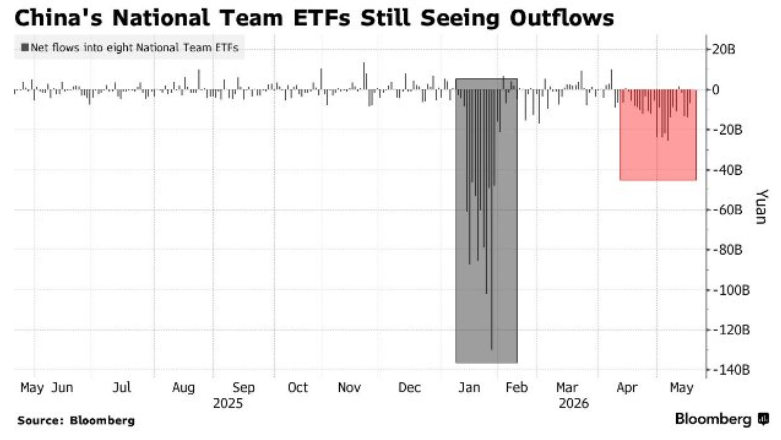
The core logic of this round of divestment lies in lowering holdings below the mandatory disclosure threshold. According to regulations, once the holding ratio falls below 20%, the relevant institutions no longer need to publicly disclose their holdings and will not appear on the shareholders list in the mid-year financial report. Analysts expect that it will take at least eight weeks to fully divest to the target level, with a divestment amount of about 90%.
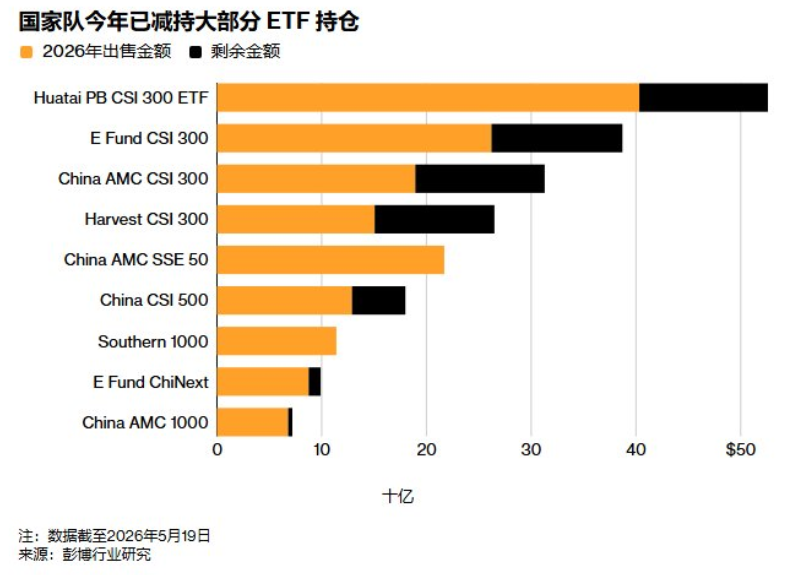
Looking at the structure of holdings, the national team has significantly reduced its stake in several major ETFs, including Huatai-Pine Blooth 300, Yifangda CSI 300, Huaxia CSI 300, and Harvest CSI 300. Among the main broad index benchmarks, the CSI 300 is the only one where the national team still holds a considerable position, which also means that its divestment process will be longer and will continue to put pressure on this index.
Bloomberg Intelligence also pointed out that this round of divestment can be seen as a long-term positive signal. Once holdings fall below the disclosure threshold, the probability of further selling will decrease, and the potential selling pressure faced by the market will narrow.
The selling pressure is currently being offset by strong buying. The number of retail accounts continues to grow, deposits in non-banking financial institutions continue to expand, and overseas investors were net buyers of Chinese stocks last month. J.P. Morgan's Shanghai-based equity strategist, Erin Zhang, stated that despite continuous redemption of ETFs, broader market indicators remain strong, "the strength of self-holding is supporting the resilience of the market."
This year, the CSI 300 index has risen about 3.3% year-to-date, significantly lagging behind the MSCI Asia Pacific Index's 17% increase during the same period, in stark contrast to the record high hit by the ChiNext Index earlier this month. The continued strong performance of technology indices and the relative weakness of large-cap stocks are not unrelated to the continuous divestment by the national team.
市场有风险,内容仅供研究参考,不构成投资建议。