Coinbase Reports Loss for the Second Consecutive Quarter, Stocks Fall Nearly 5% After Hours
Coinbase's first-quarter report card reflects a typical crypto downcycle financial statement. The company's revenue dropped to $1.41 billion, a 31% year-over-year decline, with a net loss of $394 million, marking the second consecutive quarter of losses.
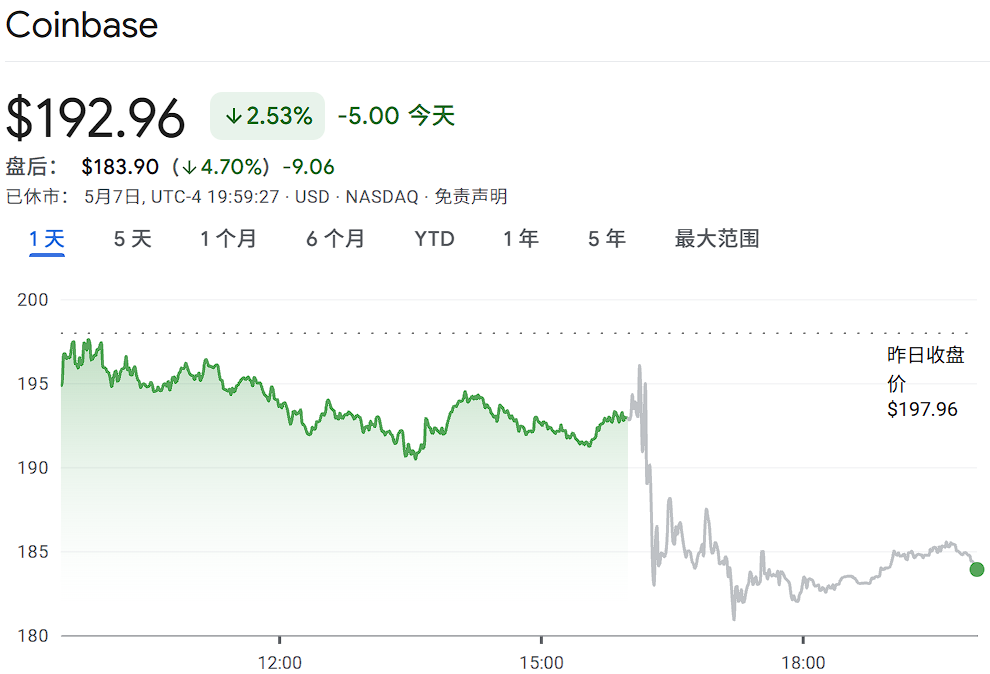
The company's stock closed at $192.96 on Thursday, down 2.53%, and further fell to $183.90 in after-hours trading, a 4.70% drop.
The main pressure stems from a decline in user trading activity. The company's monthly transacting users dropped to 8.2 million, a 15% year-over-year decrease, with trading revenue plummeting about 40% to $756 million, indicating that the retreat in crypto prices has affected user trading frequency and platform fee revenue.
Coinbase is responding to the revenue contraction by reducing costs. The company announced earlier this week a 14% workforce reduction, affecting about 700 positions, and expects to incur up to $60 million in restructuring charges. The management stated that they would dynamically adjust the cost base based on market conditions and revenue opportunities.
Predictive Markets as a New Source of Growth
Another thread in the financial report is Coinbase's efforts to reduce its reliance on spot trading cycles. The company still holds $10.2 billion in cash and cash equivalents, providing a short-term buffer; more importantly, it has 12 product lines each generating over $100 million in annual revenue.
The predictive market is the most evident new growth vector. CEO Brian Armstrong stated in the financial report that the predictive market is on the verge of becoming the 13th product line with annual revenue over $100 million, achieving a $100 million annualized revenue in less than two months. The initial liquidity was provided by Kalshi, marking the fastest product in the company's history to reach this revenue level.
Derivatives represent another path to diversify revenue. Coinbase's retail derivatives business has an annualized revenue of over $200 million, with a fourfold year-over-year increase in the U.S. derivatives market share, and it became the first platform to launch a 7×24-hour U.S. perpetual futures service.
The stablecoin business is also growing counter-cyclically. The platform's average holdings of USDC reached a historical high of $19 billion, with stablecoin revenue increasing 11% year-over-year to $305 million, becoming one of the few core data points with year-over-year growth in the financial report. However, some of Coinbase's revenue comes from a revenue share related to the USDC issued by Circle, and the stablecoin reward mechanism is still under legislative controversy in the United States, where the progress of related bills could affect
市场有风险,内容仅供研究参考,不构成投资建议。