Differences Remain in US-Iran Ceasefire Agreement: White House Says May Take Days to Finalize, Iran Denies Linking Nuclear Talks
On the 24th Eastern time, US President Trump indicated on social media that the US-Iran agreement has not yet been fully negotiated and has informed the US representatives not to rush the process.
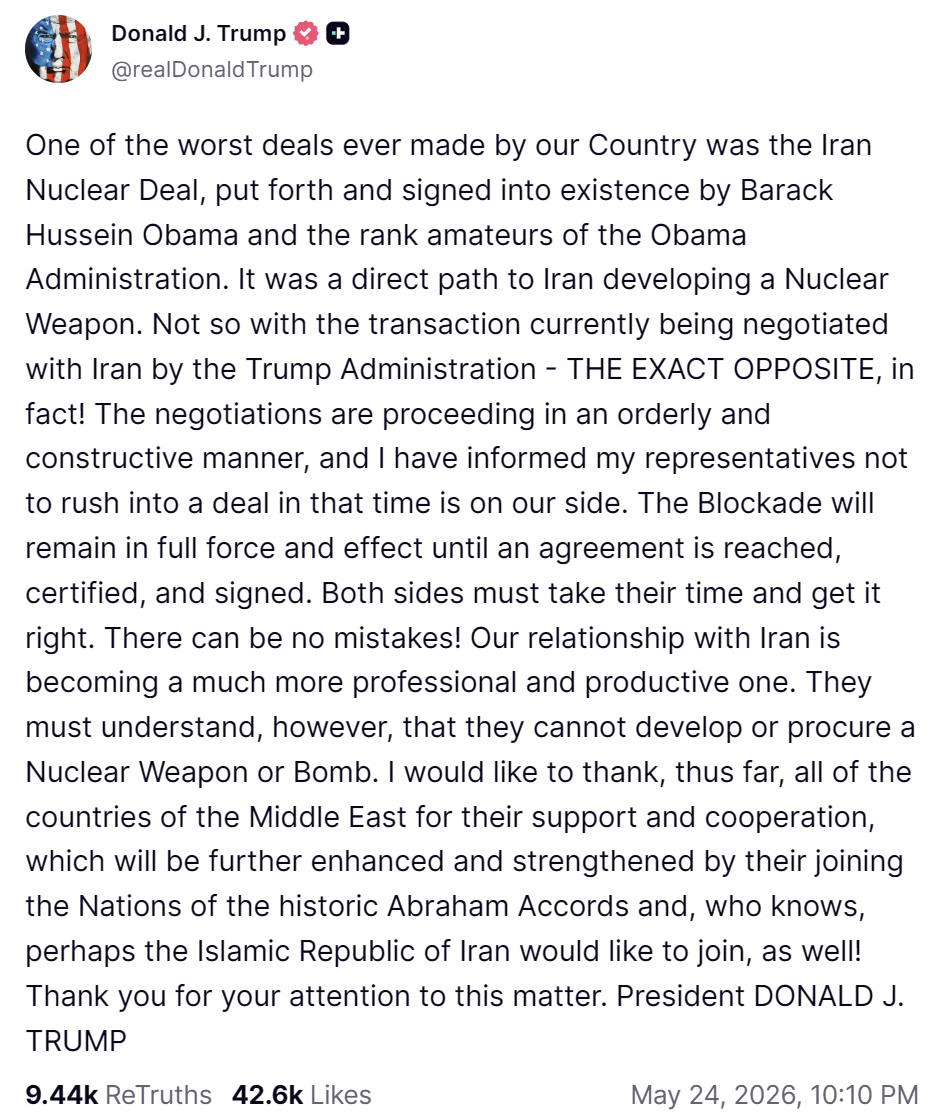
White House officials revealed at the briefing on the 24th that the agreement still requires several days to gain approval from Iran’s leadership, including the Supreme Leader, and there is still a risk of collapse. US officials emphasize that until the agreement is formally signed and ratified, the naval blockade will remain fully effective. Trump reiterated that Iran must never acquire nuclear weapons and refuted domestic US criticism that the agreement will weaken established goals.
The core conflict that the negotiations failed to finalize relates to the conflict between asset unfreezing and nuclear issues. On the evening of the 24th local time, the Iranian official explicitly denied reports about “unfreezing assets only after transferring enriched uranium reserves” and insisted on not linking the unfreezing of assets with nuclear material issues, and no commitments have been made on nuclear details at this stage. The red line for Iran is that once a mutual understanding is announced, some overseas assets must be immediately unfrozen and fully usable, otherwise, consensus cannot be reached. Iran accused the US of obstructing asset unfreezing as the main reason why the memo could not be finalized.
Regarding the roadmap for reopening the strait, on the 24th local time, Rezaei, spokesperson of the National Security and Foreign Policy Committee of Iran's Parliament, confirmed that the management of the Strait of Hormuz will not return to the pre-war status. Currently, the strait is controlled by Iran and can only facilitate the passage of ships after the war. Rezaei emphasized that Iran has not negotiated with the United States on issues related to enriched uranium stocks and will never retreat from its current position. Due to differing views on strait control and nuclear clauses, this 60-day ceasefire memorandum, aimed at easing global oil supply pressure, still faces uncertainty before its ultimate implementation.
市场有风险,内容仅供研究参考,不构成投资建议。