Foreign Purchases in US stocks slump, Europe becomes the sole dominant buyer of US debt
Bloomberg macro strategist Simon White warns that international capital is accelerating its flight from U.S. core assets, with net foreign purchases of U.S. stocks having completely stalled and approached zero in March. Despite the U.S. Treasury's latest report on international capital flows showing an overall net capital inflow of about $150 billion in March, significantly higher than the three-month and six-month average of about $100 billion, the details reveal a severe weakness in buying of U.S. core assets.
Against the backdrop of intensified AI sector speculation and bond market turmoil, global capital's net purchases of U.S. stocks have completely stalled in March, almost recording zero growth. Looking at the three-month rolling data, overseas investors' net purchases of U.S. stocks have fallen to the lowest point since last year's tariff frictions. Moreover, due to the outbreak of conflict with Iran in March, which directly depressed U.S. stock valuations, the paper shrinkage of U.S. stock assets held by foreign capital is even more severe.
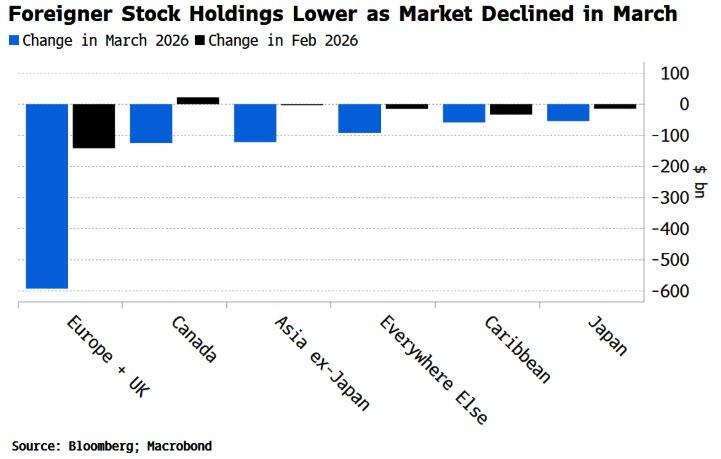
The main factor supporting the total capital inflow to the United States in March was the acceleration of U.S. domestic investors selling their overseas holdings of foreign bonds. This repatriation of profits or principal is statistically counted as capital inflow, but essentially it is just a redistribution of existing funds from one hand to the other and does not reflect the confidence of overseas investors in the U.S. market.
At the same time, the willingness of overseas funds to purchase U.S. Treasury bonds is also continuing to decline, with the three-month rolling net purchase amount having shrunk to about $50 billion. The buying power for U.S. debt is extremely singular at present, with Europe becoming the only major buyer. Simon White points out that, given the U.S.' recent frequent criticism toward Europe and its wavering stance on NATO issues, Europe's subsequent willingness to purchase is highly uncertain. Currently, foreign investors still hold as much as 30% of U.S. Treasury bonds, and in the context of global inflation risks increasing U.S. Treasury yields, the structural decline of overseas core buying orders will bring substantial pressure to the U.S. financial markets.
市场有风险,内容仅供研究参考,不构成投资建议。