Goldman Sachs warns: Macro short positions in US stocks reach a ten-year high
The S&P 500 index rose by 0.9% for the week, marking its eighth consecutive week of gains. Despite the University of Michigan's consumer sentiment index hitting a new low and weak economic data, the US stock market continues to move upward. In terms of individual stocks, Nvidia encountered selling after releasing strong financial reports, continuing the pattern of a pullback after positive releases over the past three years, but it is still expected to generate at least $20 billion in independent CPU revenue this year. Last week, the quantum computing and memory sectors led the gains, while the power grid renovation and Chinese concept stocks lagged behind.
Goldman Sachs' prime brokerage business data shows that the total net leverage ratio of long and short positions in US stocks last week marked the largest single-week increase in over three years. Capital inflows targeted information technology and discretionary consumption, while staples consumption faced net selling. Hedge funds broke their previous pattern of selling tech stocks, net buying the information technology sector at the fastest pace since mid-March, bringing their total and net exposure ratio in the prime brokerage's total book to the highest in five years.
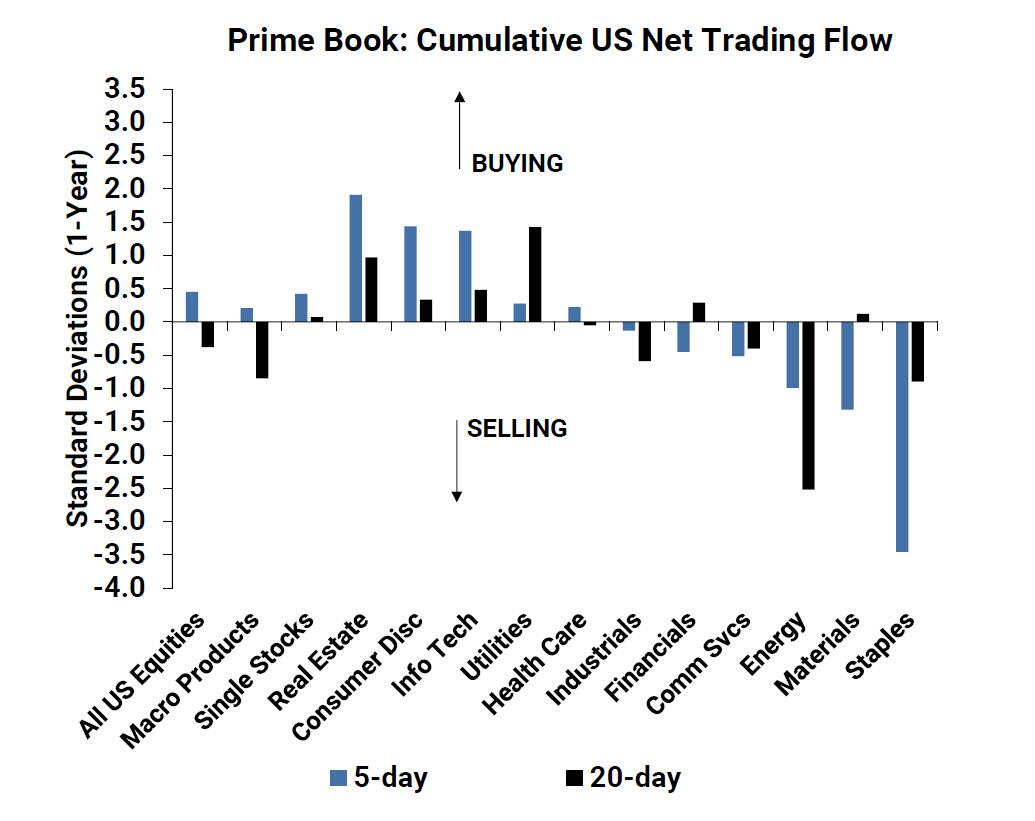
Within the consumer sector, capital flows diverged sharply. The discretionary consumption sector received net buying at the fastest pace in over two months, with funds focusing on broad-line retail and hotel tourism; the staples consumption sector, on the other hand, experienced the largest net selling in over five years. Walmart fell 7% on its earnings announcement day, marking the largest single-day drop in three years and intensifying market concerns about weakening consumption, but discount retailers like TJX indicated that demand remains strong.
Goldman Sachs' Delta One trading desk pointed out that the risk of short squeezes on the US stock index level has risen to a 10-year high. Due to anxiety over interest rates and geopolitical issues, investors generally avoid shorting individual stocks and instead, heavily short macro indices and ETFs. Last week, large-cap and technology ETFs saw short covering, prompting a 4% decrease in the overall short position of US-listed ETFs for the first time in three weeks.
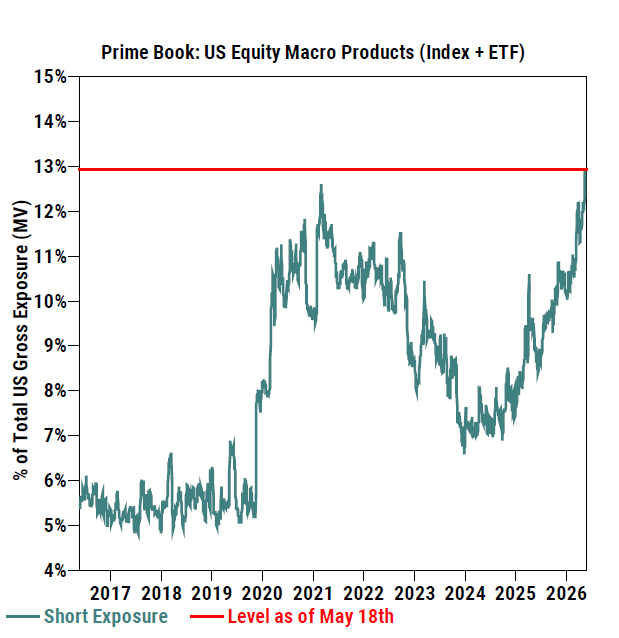
The data from the derivatives market also shows extreme risk, with the single-day trading volume of S&P 500 call options reaching $2.6 trillion earlier this month. Currently, nearly 25% of the top 100 stocks in the S&P have experienced a call option skew reversal, a characteristic highly consistent with the period of retail investor short squeezes in 2021.
市场有风险,内容仅供研究参考,不构成投资建议。