IEA: Global electric vehicle sales to exceed 20 million by 2025
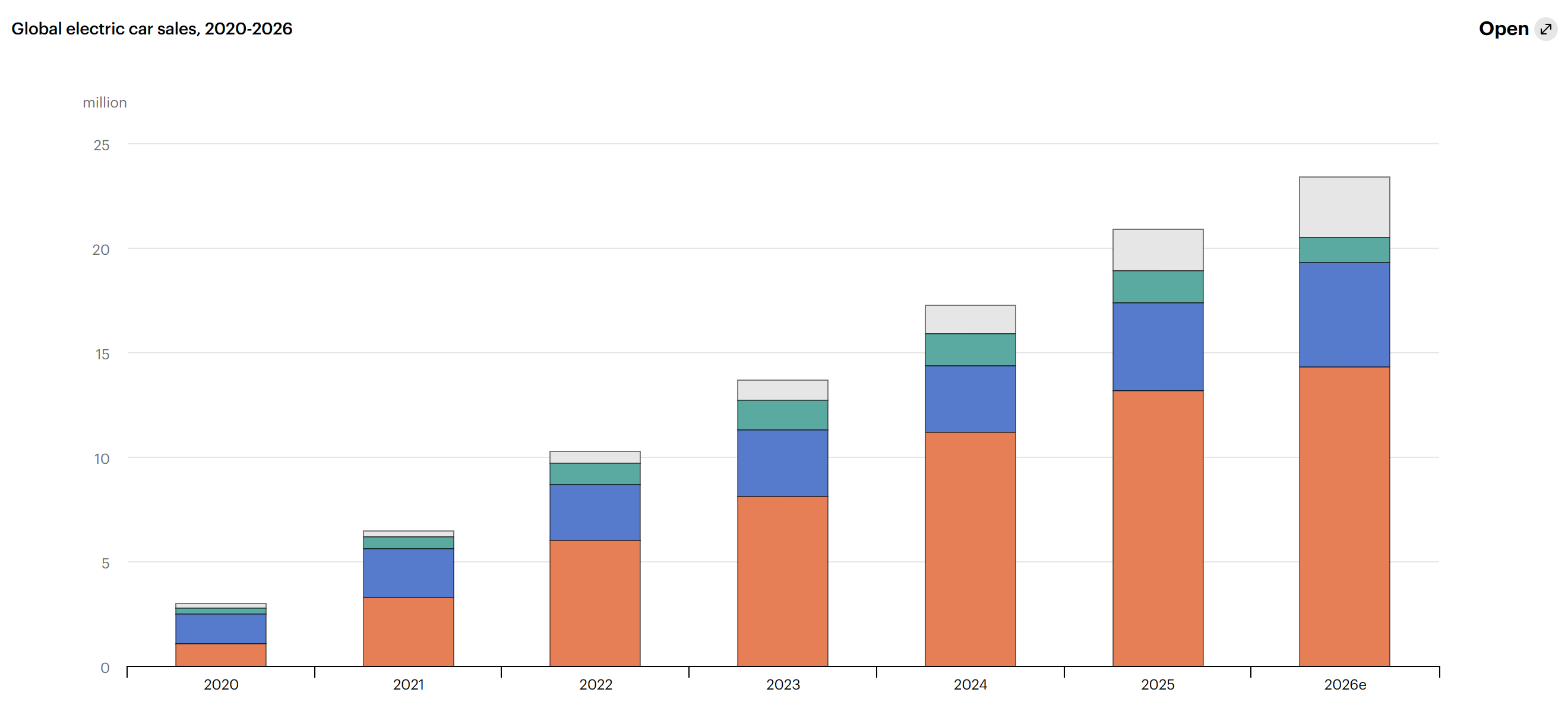
The International Energy Agency (IEA) released a report titled "Global Electric Vehicle Outlook 2026," which shows that in 2025, global electric vehicle (EV) sales surpassed the historic milestone of 20 million units, accounting for a quarter of total global new car sales.
This achievement not only aligns with market expectations but also marks the fifth consecutive year that global EV sales have achieved an annual incremental increase of about 3.5 million units, signifying that the transition to clean transportation has entered a scaled-up new phase of steady growth.
By the end of 2025, electric cars accounted for about 5% of the total global vehicle fleet, replacing a daily average of 1.2 million barrels of crude oil, exerting a substantial push for the global energy structure transition and carbon emission reduction.
Europe and China Lead the Global Market
China maintained its position as the world's largest EV market in 2025, with annual sales exceeding 13 million units, accounting for 60% of the global total. The market penetration rate exceeded 50% for 11 months of the year.
Spurred by stringent CO2 emission standards for passenger cars in the European Union, the European market welcomed a robust recovery in 2025, with sales increasing by 30% year-on-year to 4.2 million units, representing 28% of its new car total sales. Notably, Germany, the largest automotive market in Europe, saw EV sales soar by 50% to a record high of 850,000 units in 2025, primarily due to corporate car purchase tax incentives and the popularization of low-cost models.
Policy Shift Causes U.S. Market Stagnation
Contrasting with the booming markets in China and Europe, the U.S. EV market's sales volume remained roughly at 1.5 million units in 2025, nearly unchanged from the previous year, with its share of the new car market stabilizing at just below 10%.
This stagnation is mainly attributed to a significant policy adjustment in the second half of the year. A related bill passed in July eliminated financial penalties for car manufacturers not meeting targets and terminated tax credits for both new and used electric car purchases starting from September of that year. As a result, U.S. EV sales in the fourth quarter plummeted by 45% year-on-year, directly offsetting the nearly 15% growth in the first three quarters, highlighting the short-term pain of policy subsidy withdrawal on North American electrification transformation.
Emerging Markets and Technology Routes Accelerate Differentiation
The emerging markets contributed nearly 2 million in sales volume in 2025, with a year-on-year increase of nearly 50%, where Chinese-made low-cost models became the core force driving adoption.
Regarding the product technology structure, Battery Electric Vehicles (BEVs) regained favor in 2025, with their share of global EV sales rebounding to 65%, reversing the decline from the past two years due to the rise of plug-in hybrids. In contrast, Extended-Range Electric Vehicles (EREVs), which had seen strong growth in 2024, cooled off in 2025, with global sales share dropping to below 7%, indicating a resurgence in consumer confidence in mainstream pure electric vehicle paths.
市场有风险,内容仅供研究参考,不构成投资建议。