Leveraged ETF Surge, Increased Short Selling Pressure Might be the Main Cause for Semiconductor Sector Correction
The TMT strategist at Goldman Sachs, Peter Bartlett, pointed out in the latest trading notes, the Philadelphia Semiconductor Index has skyrocketed by 66% since the end of March. This fierce rebound is not only due to the upward revision of earnings expectations but is also strongly boosted by unique capital flow dynamics.
Although long-term capital continues to flow into AI winners to support the sector's rise, the surge in leveraged ETFs in the short term, the concentrated betting of retail investors, and short covering are making the market face the risk of a pullback.
Capital is pouring into the semiconductor sector at an unprecedented speed, especially through high-leverage tools. Data shows that the nominal trading volume of the 3x long semiconductor ETF reached $9.5 billion in a single day, and the underlying nominal principal is as high as about $30 billion. At the same time, the DRAM memory ETF, which was just launched on April 2, is also showing a parabolic increase in its asset scale and trading volume. This explosive growth in trading volume indicates that market sentiment is extremely excited.
Retail investors are also highly involved and concentrated on a few popular stocks. Social media data shows that Micron Technology, AMD, and NVIDIA are among a few semiconductor giants that occupy the top of the discussion. This concentration of funds in a narrow group of stocks increases the volatility of individual stock prices. In addition, the sharp increase in call option trading volume for Micron Technology also indirectly confirms that retail investors are increasing their use of leverage to chase momentum.
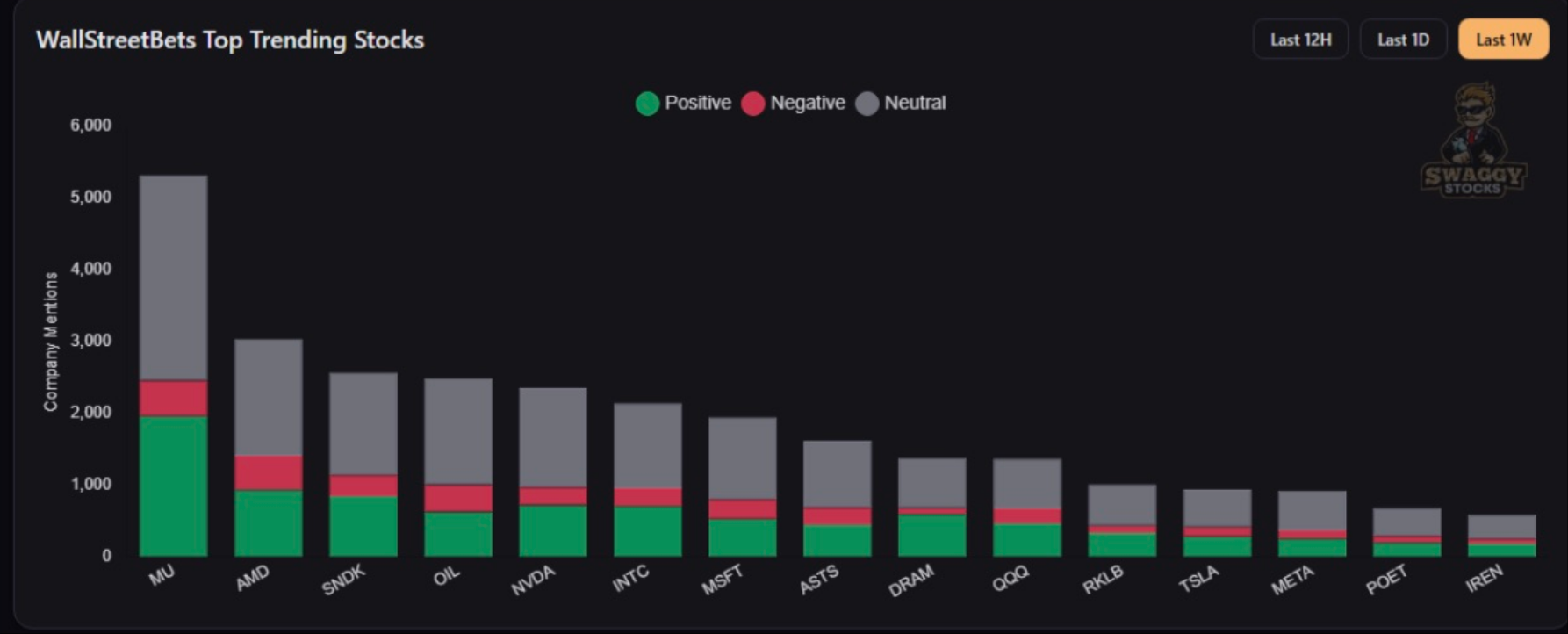
In addition to retail investors, institutional momentum factor trading is also adding fuel to the rally. Goldman Sachs data shows that semiconductors and hardware sectors have a very high weight in their momentum long portfolio. As momentum strategies increase their influence across the market, this clear factor trading adds extra fuel to the semiconductor sector's rise, further amplifying the winner-take-all situation in the short term.
On the other hand, the disintegration of the short position is also accelerating the stock price increase. Although the semiconductor sector is not heavily shorted as a whole, the sharp rise has led to a significant increase in the notional value of short positions, forcing some shorts to cover. Recently, there have been significant signs of short covering in individual stocks such as Intel, Qualcomm, and AMD, and this buying force has further pushed up stock prices in the short term.
In the face of such intense capital flows, Goldman Sachs
市场有风险,内容仅供研究参考,不构成投资建议。