Micron Market Value Breaks the $900 Billion Mark for the First Time
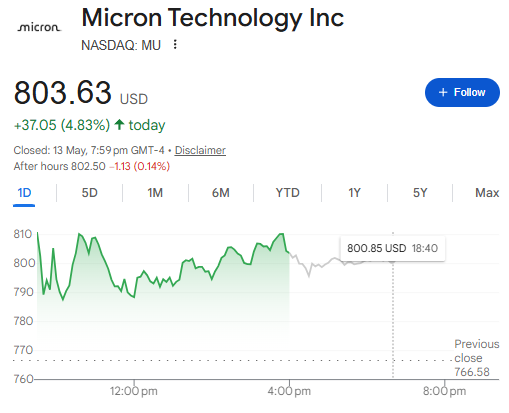
On May 13th, local time, negotiations between Samsung Electronics' labor union and management collapsed, with over 50,000 workers threatening to launch an 18-day comprehensive strike starting on May 21st. Following the news, Micron Technology's stock closed up 4.8% at $803.63, with its market value surpassing $900 billion for the first time, reaching $906.28 billion.
Samsung union representative Choi Seung-ho stated outside the negotiation room in Seoul: "None of the issues raised by the union has been addressed." He also mentioned that there are no plans to resume negotiations before the strike, but if the company proposes a formal plan, they are willing to consider it. The negotiations, which lasted two days with the mediation of the South Korean government, ended in failure.
The core dispute between labor and management focused on bonus distribution: the union demanded 15% of operating profits for bonuses with no cap, while Samsung only offered a 10% plan. Samsung stated it would continue efforts to prevent the strike, and the union is seeking to clear legal obstacles to calling for a strike. If the strike proceeds as scheduled, the number of participants will exceed 50,000.
According to Jefferies' estimates, this strike could affect approximately 3% of the global memory chip production capacity. The memory chip market is already in a historic supply shortage due to the explosive construction of AI data centers. Any disruption in Samsung's production could accelerate customer orders shifting towards Micron, coupled with expectations of further price increases for chips, Micron's revenue prospects will significantly improve. SK Hynix also benefited from the market sentiment, with its stock price rising 7.7% in the South Korean local market that day. Sandisk, which competes with Samsung in NAND, saw a slight decrease of 0.3%.
This surge has narrowed the gap between Micron and the 11th-ranked Eli Lilly to about $50 billion, putting it just one step away from joining the top ten in the United States. Over the past 12 months, Micron's stock price has more than doubled, with the expansion of AI-driven memory demand being the core logic, and Samsung's labor crisis adding another variable to this trend.
市场有风险,内容仅供研究参考,不构成投资建议。