Middle East Conflict Disrupts Sulfur Supply Chain, Global Phosphate Fertilizers Face Supply Disruption Shock
The conflict in the Middle East has led to the obstruction of the shipping routes in the Strait of Hormuz, impacting the supply of sulfur—a key global crop nutrient. Sulfur is a core ingredient in the production of phosphate fertilizers, which are used for the cultivation of crops such as corn, soybeans, and rice. Before the outbreak of war in late February 2026, approximately 50% of global sulfur trade was transported through this strait. The disruption of these shipping lanes has triggered a fertilizer supply crisis, with global phosphate fertilizer supplies facing pressure.
Due to a lack of raw materials, sulfur prices have risen from between $150 and $180 per ton a year ago to the current range of $850 to $900. High costs have led to a turn to negative profits in some production, prompting American fertilizer giant Mosaic to reduce production in Brazil and the United States. Although the world's largest phosphate fertilizer exporter, the OCP Group, has inventory to last until the end of July, it has also reduced output by bringing forward maintenance schedules. To stabilize domestic supplies, China has announced a suspension of major phosphate fertilizer exports until at least August. In the meantime, India has recently launched a fertilizer procurement tender of 1.6 million tons. Saudi producers have attempted to transfer goods by land routes, but export volumes have still been reduced by about half.
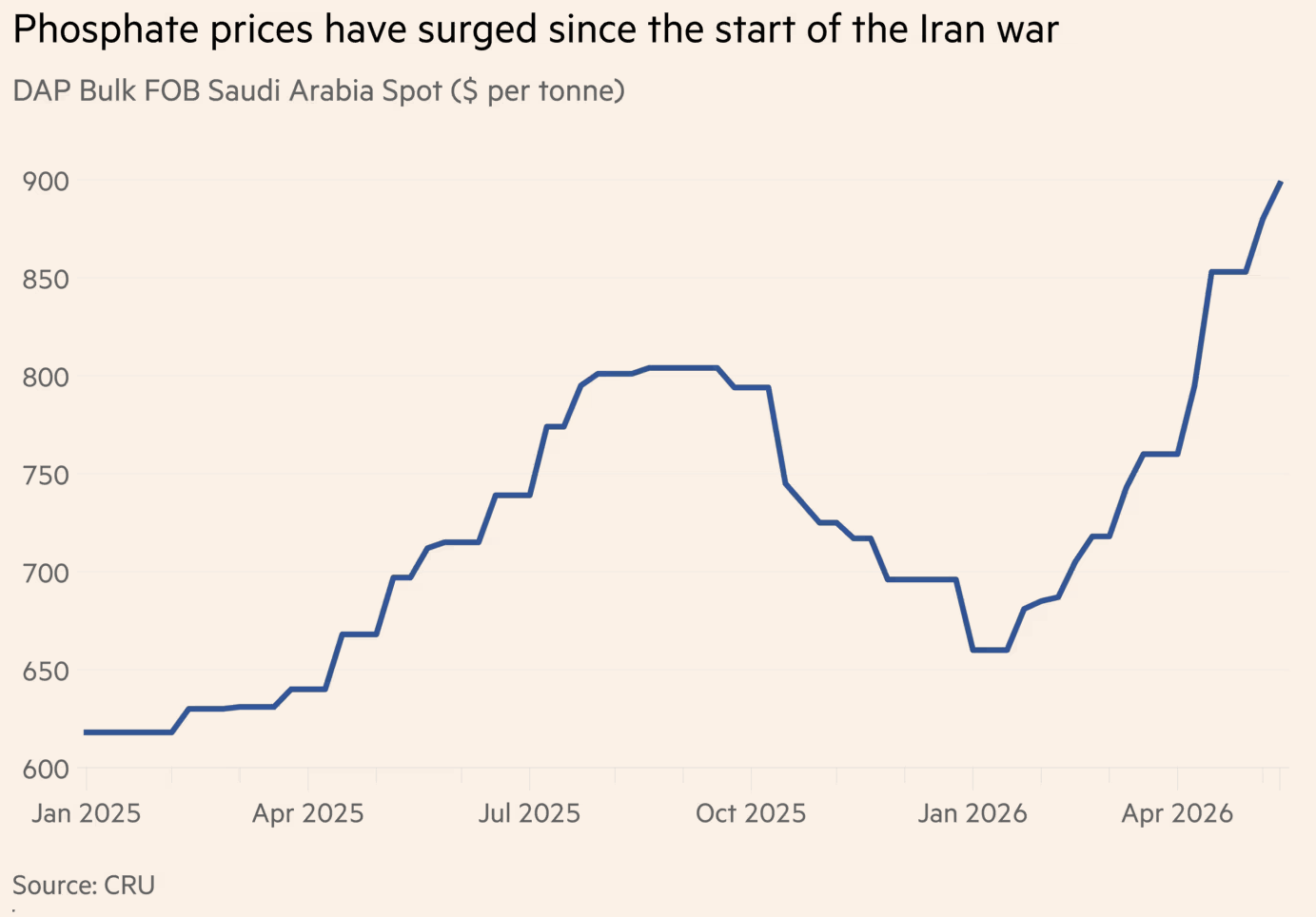
Consulting firm CRU has pointed out that even if shipping lanes are reopened, the phosphate fertilizer market, which heavily relies on Gulf sulfur, will take a longer time to recover. The current high prices are forcing farmers in less developed regions such as Southeast Asia and Africa to reduce the application of phosphate fertilizers. Commodity research organization ICIS warns that a lack of key nutrients will lead to a decline in overall crop yields, and global food harvests could be affected as early as next year, with some regions facing the risk of famine.
市场有风险,内容仅供研究参考,不构成投资建议。