Musk vs. OpenAI Trial Starts, Market Win Probability Rises to 55%
Elon Musk's lawsuit against OpenAI, Sam Altman, Greg Brockman, and Microsoft has entered the trial phase in the federal court in Oakland, California. On April 27, nine jurors were selected; opening statements are scheduled to begin on April 29, with the evidence phase expected to last for several weeks into mid-May, followed by jury deliberation.
The heart of this lawsuit is the governance boundaries of OpenAI after its transition from a non-profit organization to a commercialized entity. Musk accuses OpenAI of abandoning its 2015 founding promise of "benefiting humanity and remaining non-profit," with the case currently focusing on two claims of breach of charitable trust duties and unjust enrichment. Musk's maximum claim amount is between $134 billion and $150 billion; in addition to compensation, he also demands the reversal of the for-profit restructuring and the removal of Altman and Brockman.
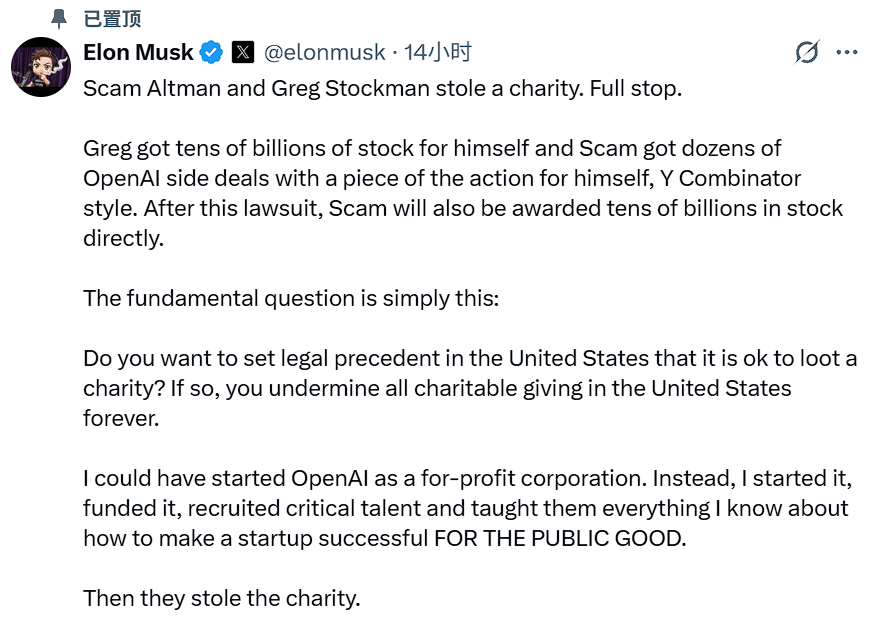
The court-outside confrontation is equally intense. Musk called Altman "Scam Altman" on X, referred to Brockman as "Greg Stockman," and claimed that he could have made OpenAI a for-profit company back then but chose to invest money, recruit talent, and establish a non-profit organization serving the public interest, only to be "stolen" in the end. OpenAI countered that this lawsuit is "baseless and driven by competitive jealousy."
From Co-Founding to Rupture
The beginning of this conflict can be traced back to 2015. At that time, Altman was still the president of Y Combinator, and Musk was an early key investor in OpenAI. Both worried about Google DeepMind's dominance and thus promoted the establishment of OpenAI with non-profit, open-source, and service to all of humanity as its goals.
The rift began with financial pressure. Training large models requires continuous investment, and OpenAI's research and development progress was behind DeepMind in the early days. The team began discussing the for-profit transformation in 2017. It is reported that Musk did not initially oppose commercialization, but he demanded a majority stake, absolute control, and the CEO position, which Altman did not accept. In
市场有风险,内容仅供研究参考,不构成投资建议。