OpenAI Introduces Daybreak to Compete with Claude Mythos
OpenAI launched Daybreak on Tuesday, attempting to integrate AI network defense from post-scan to the everyday processes of software development. Sam Altman stated that AI has already become proficient in cybersecurity and will become even stronger soon, with OpenAI seeking to collaborate with as many companies as possible at this stage.
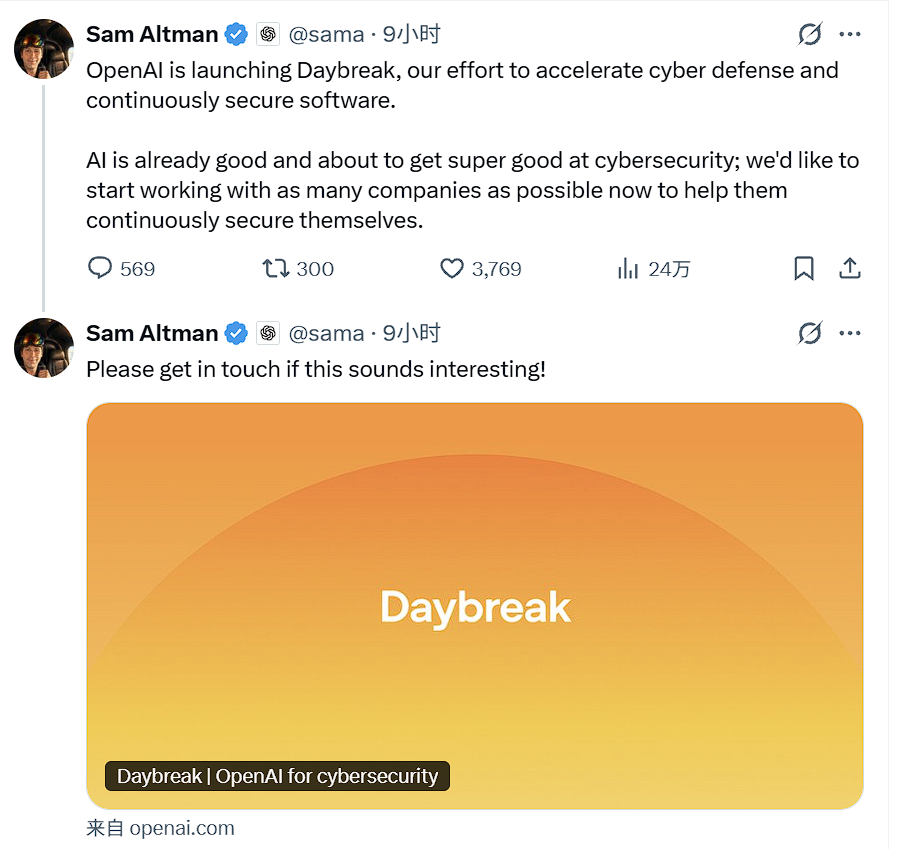
The focus of Daybreak is not just discovering vulnerabilities, but also shortening the chain from identifying risks to the verification of fixes. OpenAI claims that AI can reason across codebases, discover subtle vulnerabilities, verify patches, analyze unfamiliar systems, and bring repair suggestions back into the development process.
This solution relies on the Codex Security agent, which can build an editable threat model from a company's codebase, analyze real attack paths, validate potential vulnerabilities, and automatically detect high-risk issues.
The value of such products for enterprise customers lies in reducing the disconnect between security and development teams. Security code reviews, threat modeling, patch validation, dependency risk analysis, and detection/response, if integrated into the same workflow, would no longer be a remedial action taken only after deployment.
OpenAI has set up different access levels in Daybreak, with the default version being GPT-5.5, GPT-5.5 with Trusted Access for Cyber, which is geared towards authorized defense work, has more sophisticated protection mechanisms, and GPT-5.5-Cyber is aimed at more specialized authorized red teams, penetration testing, and controlled validation scenarios.
市场有风险,内容仅供研究参考,不构成投资建议。