Retail Investors Holding 12 Trillion USD, Reshaping U.S. Stock Valuation Mechanism
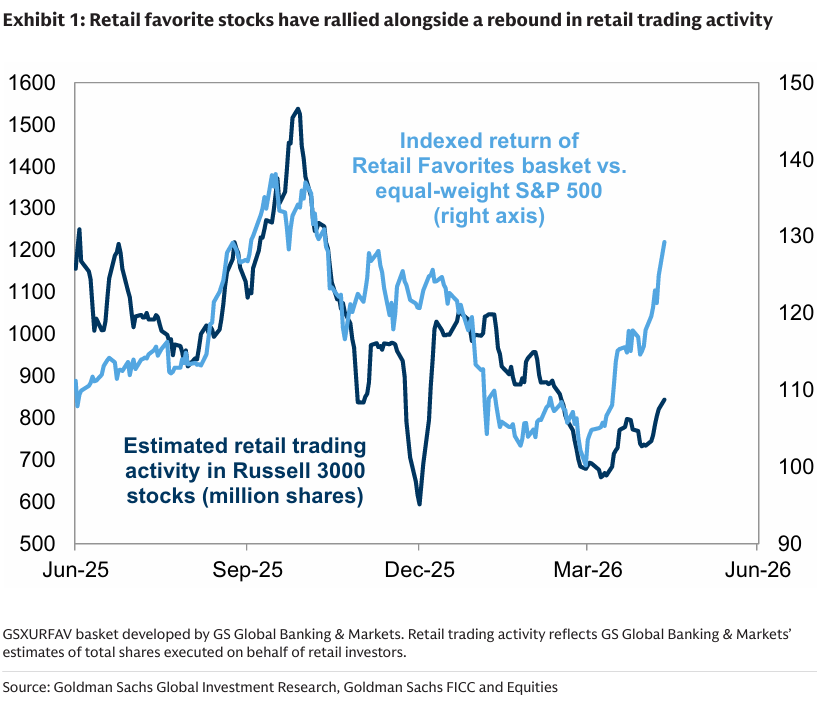
A report from Goldman Sachs Investment Research on May 13th indicated that since mid-April 2026, retail trading volume has increased by 28%, and the "favorite stocks basket" tracked by Goldman Sachs has risen by 29% during the same period, outperforming the broader market. Recently, regulatory authorities have replaced the "typical day trader rule" with more lenient margin requirements, further opening up space for the rise in retail investor activity.
In terms of volume, American households are the largest holders of U.S. stocks, with retail investors' stock assets in self-directed brokerage accounts estimated at $12 trillion, accounting for about 10% of the total market capitalization of U.S. stocks. Wealth is highly concentrated, with the top 10% of wealthy families holding 87% of stock assets, but the turnover rate and capital flow adjustment of the bottom 50% of families are three times that of the former. Retail assets are mainly concentrated in the three major brokers Charles Schwab, Fidelity, and Vanguard, accounting for about 79% in total, while Robinhood and Interactive Brokers each account for only about 2% of assets, but contribute to extremely high trading frequency.
In terms of trading volume, over the past four quarters, retail investors have accounted for 19% of total U.S. stock trading volume, which is higher than the 15% ten years ago, but lower than the peak of 24% during the 2021 group buying trend. It is worth noting that about 87% of retail orders are routed to specialized market makers, of which 84% are internally digested, meaning that institutional investors can actually only directly interact with a very small part of retail order flow.
市场有风险,内容仅供研究参考,不构成投资建议。