U.S. Stock Profit Growth Far Exceeds Expectations, Record-Breaking Market Gains Underpinned by Fundamentals
The US stock market, which was originally disturbed by the Iran war, is being supported again by a series of better-than-expected earnings reports. Bloomberg Industry Research data shows that the profits of S&P 500 companies for the first quarter currently grew by 27%, which is more than double the analysts' previous expectation of around 12%.
According to Bloomberg Industry Research data, this is the most significant case of corporate profits exceeding expectations since at least 2013, excluding the COVID period; if the recovery period after significant shocks is excluded, the last similar year-on-year profit growth can be traced back to 2004.
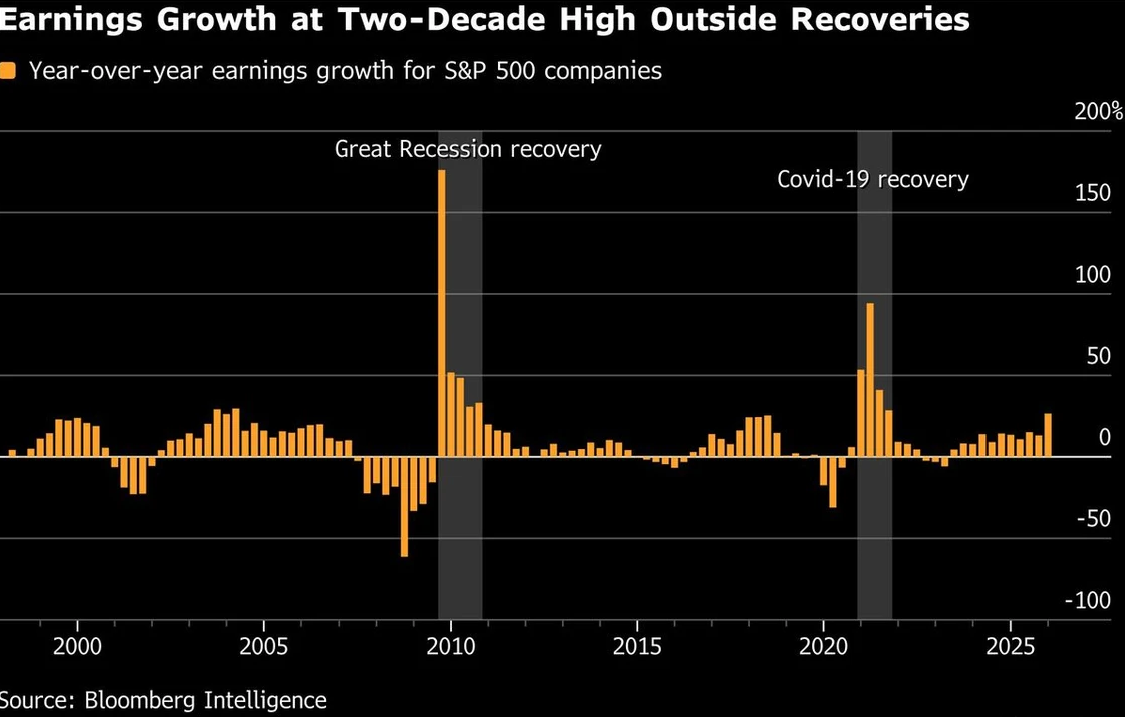
This round of earnings reports has made Wall Street's initial judgments appear conservative, forcing them to revise their assumptions. Bank of America initially expected the S&P 500 companies to achieve profits of $305 by 2026, but Robert Haworth, the senior investment strategy director of the bank's wealth management department, said the performance in the first quarter is strong enough to push them to increase their full-year profit forecast and possibly adjust the year-end S&P 500 target.
The other key to the profit surprise is that the coverage is expanding. About 85% of S&P 500 companies' profits exceeded analysts' expectations, according to Societe Generale strategists, the highest proportion in five years; Deutsche Bank strategists pointed out that all 11 sectors of the S&P 500 achieved positive growth for the first time in four years, and increased their 2026 earnings per share forecast by nearly 7% to $342.
AI remains the strongest source of profit growth. Data compiled by Bloomberg Industry Research shows that the profits of Nvidia, Microsoft, Alphabet, Amazon, Meta, Apple, and Tesla, seven companies, are expected to grow by 57% in the first quarter, significantly higher than the expected 17% profit growth of the rest of the S&P 500 companies.
This is also why the US stock market can handle geographical shocks. The head of multi-asset strategy at HSBC, Max Kettner, said that the outlook for oil prices and geopolitical tensions indeed affect interest rate and exchange rate markets, but what is truly key for the US stock market, credit markets, and broader risk assets is the backdrop of economic activity and profitability.
Strong profits have also raised market expectations for subsequent performance. The S&P 500 has rebounded by more than 16% from the low point in March, and has been close to the overbought range since mid-April. The recent increase in semiconductor stocks has also made some investors worry that the stock prices have already discounted some profit improvement in advance.
市场有风险,内容仅供研究参考,不构成投资建议。