US Non-farm Payroll Increase by 115,000 in April, Unemployment Rate Stays at 4.3%
The US added 115,000 jobs in the April non-farm payrolls, higher than the market expectation of 65,000, with the unemployment rate remaining at 4.3%, consistent with expectations and the previous figure. Although the increase in employment was lower than the revised 185,000 in March, the continuous signs of improvement indicate that the labor market has not continued to deteriorate.
The job market is becoming stable from its previous downturn. The increase of 115,000 in non-farm payrolls in April marks the first time in nearly a year that there has been consecutive growth, showing that the labor market is stabilizing after almost zero growth last year.
The private sector remains the main support. In April, the private sector added 123,000 jobs, offsetting the reduction of 8,000 government positions. Average hourly wages rose by 0.16% month-on-month and 3.57% year-on-year, with wage growth remaining moderate.
There have been significant revisions to the data for the previous two months. The non-farm payrolls for March were revised up to 185,000, while those for February were revised down to a decrease of 156,000, indicating that recent employment data fluctuations are still high, and the market still needs more months of data to confirm whether the labor market has truly stabilized.
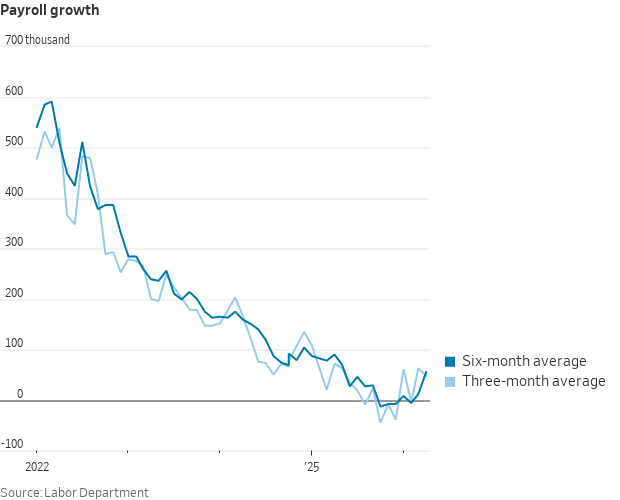
The Wall Street Journal reporter Nick Timiraos, known as the "Fed Mouthpiece," pointed out that the household survey employment fell by 226,000, the labor force decreased by 92,000, and the labor force participation rate decreased by 0.1 percentage point to 61.8%.
Nick Timiraos believes that the unemployment rate did not rise, not because more people found jobs, but because some people left the labor market. He also mentioned that the average number of jobs added in the United States over six months rose to 55,000, the highest level since May 2025.
BlackRock Portfolio Manager Jeffrey Rosenberg said there is a "trade-off" between strong non-farm payroll numbers and weaker wage growth. In his view, this report did not release any significant change signals, and for the Fed, it is more like a reason to maintain the status quo.
He further mentioned that the current macroeconomic data pricing logic is already dominated by the AI theme.
"When we look at GDP data and expenditure, the driving factor is no longer mainly consumption, but more capital expenditure. When looking at financial markets, what is truly significant is also more the impact brought by AI."
市场有风险,内容仅供研究参考,不构成投资建议。