Tech Titans' Free Cash Flow Hits a Decade Low
According to a report from the Financial Times, AI investments by Amazon, Alphabet, Microsoft, and Meta are entering a phase of cash flow pressure. Wall Street expects that the combined free cash flow of the four companies for the third quarter will fall to about $4 billion, significantly lower than the average of $45 billion per quarter since the pandemic.
Free cash flow, which is the money left over after covering operating costs and capital expenditures, is directly related to debt repayment, share buybacks, and dividends. Analysts' expectations compiled by Visible Alpha show that the four companies' annual free cash flow will drop to the lowest level since 2014, when their revenue was only about one-seventh of their current size.
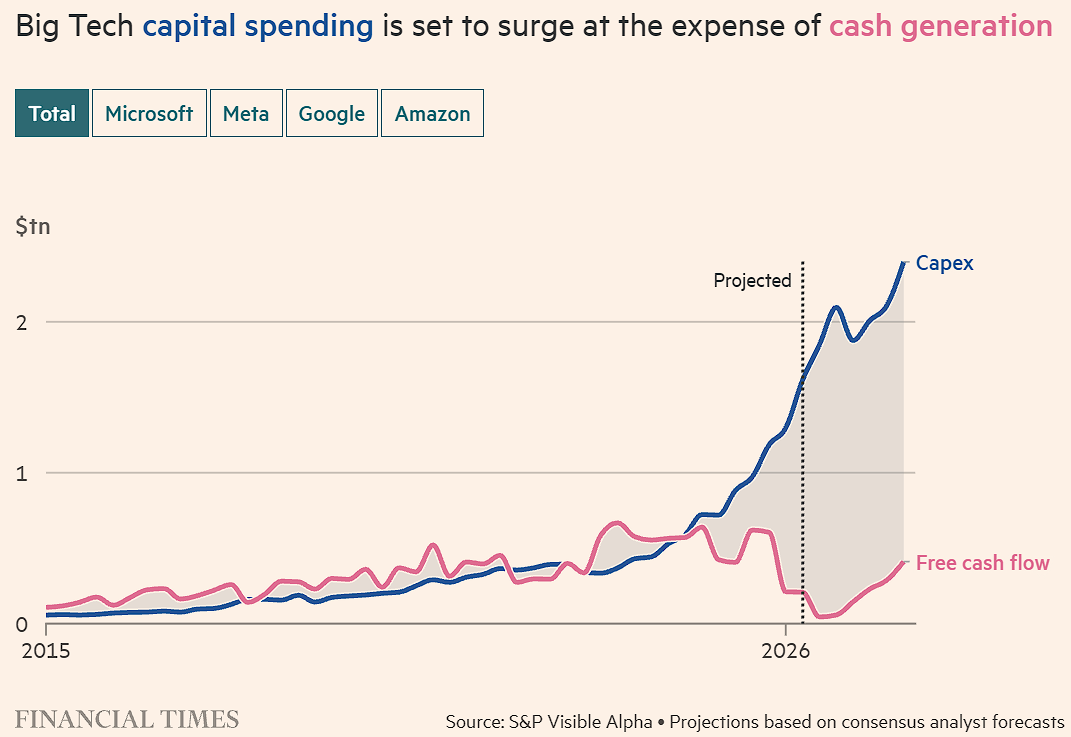
Capital expenditures for the four major technology companies are expected to continue rising in 2026, while free cash flow is projected to decline in tandem
This means that AI investments are changing the core framework by which the market assesses technology giants. In the past, these companies were seen as asset-light cash-generating machines; now, they are increasingly resembling infrastructure investors with high capital expenditures.
Justin Post, an internet analyst at Bank of America, stated that this is the deepest capital expenditure cycle the industry has ever experienced. He believes that these companies view AI as a once-in-a-lifetime opportunity, hence their willingness to prioritize infrastructure investments over short-term shareholder returns.
The pressure is already evident in capital allocation. Alphabet did not repurchase shares in the first quarter, the first time since its 2015 buyback program started, and it issued $31 billion in new debt during the quarter, followed by $17 billion in Euro and Canadian Dollar bonds this Tuesday.
Meta has also issued $55 billion in debt over the past six months and has suspended share buybacks, marking the longest pause since it began repurchasing in 2017. As Meta lacks a cloud business to directly rent out data center capacity, the market finds it harder to gauge when these investments will translate into stable cash returns.
Amazon is expected to consume about $10 billion in cash this year and has stated that it will invest $200 billion by 2026, a scale higher than its peers. CEO Andy Jassy likens this AI buildup to the early AWS investment, believing that related free cash flows and return on invested capital will become more attractive several years after being put into use.
The divergence lies in whether this construction round is locking in AI demand ahead of time or reenacting the capital cycle of heavy-asset industries. Christian Leuz, a professor of accounting at the University of Chicago's Booth School of Business
市场有风险,内容仅供研究参考,不构成投资建议。