
Blog
How to Use AI to Analyze a Company: Generate a One-Pager with a Single Sentence
Using AI to analyze a public company can start with a single sentence. In nashnova, enter a company name or stock ticker and mention that you need a "one-pager." The Agent will automatically retrieve market data, financials, earnings calls, and recent events, then organize core thesis, valuation, catalysts, risks, and sources into an A4 company research one-pager.
On September 15, 2026, we ran a real test using Apple. The complete input was just one sentence:
Generate a one-pager for Apple
No field list, no specified data sources, and no pre-prepared page template. Once the task was completed, the nashnova Agent delivered a web preview and a single-page A4 PDF.
This AI Company Analysis Test | Result |
|---|---|
Input | Generate a one-pager for Apple |
Research Subject | Apple (AAPL) |
Automatically Retrieved Information | Market data, financials, earnings calls, company events, price trends |
Final Deliverable | Web preview and single-page A4 PDF |
Page Content | Core thesis, key data, investment logic, catalysts, risks, sources |
This type of AI company analysis doesn't just "generate another company introduction." It organizes stock research information scattered across different sources into a structurally consistent deliverable that can be downloaded and reviewed.
Apple is only the demonstration subject here, not the investment theme of this article. The following sections explain what a company research one-pager is, what the Agent automatically completes, and how this approach can be applied to other public companies.
What Is a Company Research One-Pager?
When researching a company, it's easy to slide from one question into a dozen open tabs: first checking the stock price, then financial statements, then searching for news, earnings calls, and product launches. Each has value, but without a unified structure, what you end up with is often just a folder of materials.
A company research one-pager is a research map for quickly understanding a public company. It doesn't try to fit in all available information. Instead, it prioritizes answering a few fundamental questions:
What business and revenue structure currently supports the company's operations;
What trend the latest financial performance is on;
What market expectations the stock price and valuation reflect;
What events could cause the thesis to change;
What risks the current view faces, and what evidence can be used to verify it.
When these questions are placed on the same page, the relationships between pieces of information become clearer. Financial data is no longer an isolated number, and product events are no longer just news headlines — they are placed back into the same research logic.
The traditional approach usually requires selecting a template, listing fields, finding data, and then formatting everything yourself. The nashnova Agent has encapsulated this entire task structure in its "Company One-Pager" Skill. Users don't need to learn how to design a one-pager before they can start researching.
How to Use AI to Generate a Company Research One-Pager?
The complete input used in this test was:
Generate a one-pager for Apple
The sentence contains only two key pieces of information: the research subject is Apple, and the deliverable format is a one-pager.
The Agent identifies the company and its trading ticker, then initiates the corresponding research workflow based on the "one-pager" deliverable requirement. Sections such as business structure, market data, financials, valuation, recent events, catalysts, and risks do not need to be listed by the user one by one; page size, reading order, and PDF output also do not require separate formatting instructions.
This is different from asking a general-purpose AI to "tell me about Apple." The latter typically produces a text-based answer, while "one-pager" describes a task with a clearly defined deliverable: information needs to be retrieved, filtered, organized, and ultimately placed into a complete page.
Users can also add constraints in the same sentence, such as specifying a language, focusing on a particular business segment, or requesting a specific data point in time. However, these are optional conditions, not prerequisites for starting the task.
What Does an AI Company Analysis Tool Automatically Complete?
Although the input is very short, the task itself is not simplified into a single text generation.
In this Apple test, the nashnova Agent first planned the information to be covered, then called financial data and research tools to retrieve and organize:
Apple and AAPL's company identity and market data;
Financial statements and key data from recent quarters;
Management commentary from earnings calls;
Recent company events and product timelines;
Price trends and related technical data.
These steps are displayed on the task page. Users can see what types of evidence the Agent is reading and what stage it is currently at, but they don't need to open tools or transfer data themselves.
After data retrieval is complete, the Agent performs two layers of organization.
The first layer is research organization: extracting core judgments from scattered information, connecting facts with potential implications, while preserving risks, counter-conditions, and evidence boundaries.
The second layer is deliverable organization: converting content into a stable single-page structure, generating the web page and PDF, and checking whether the file fits exactly one page, whether the text is readable, and whether sources and footer information have been cut off.
As a result, what you receive is not a forcibly shortened chat transcript, but a reorganized research document.
What Does an AI-Generated Company One-Pager Include?
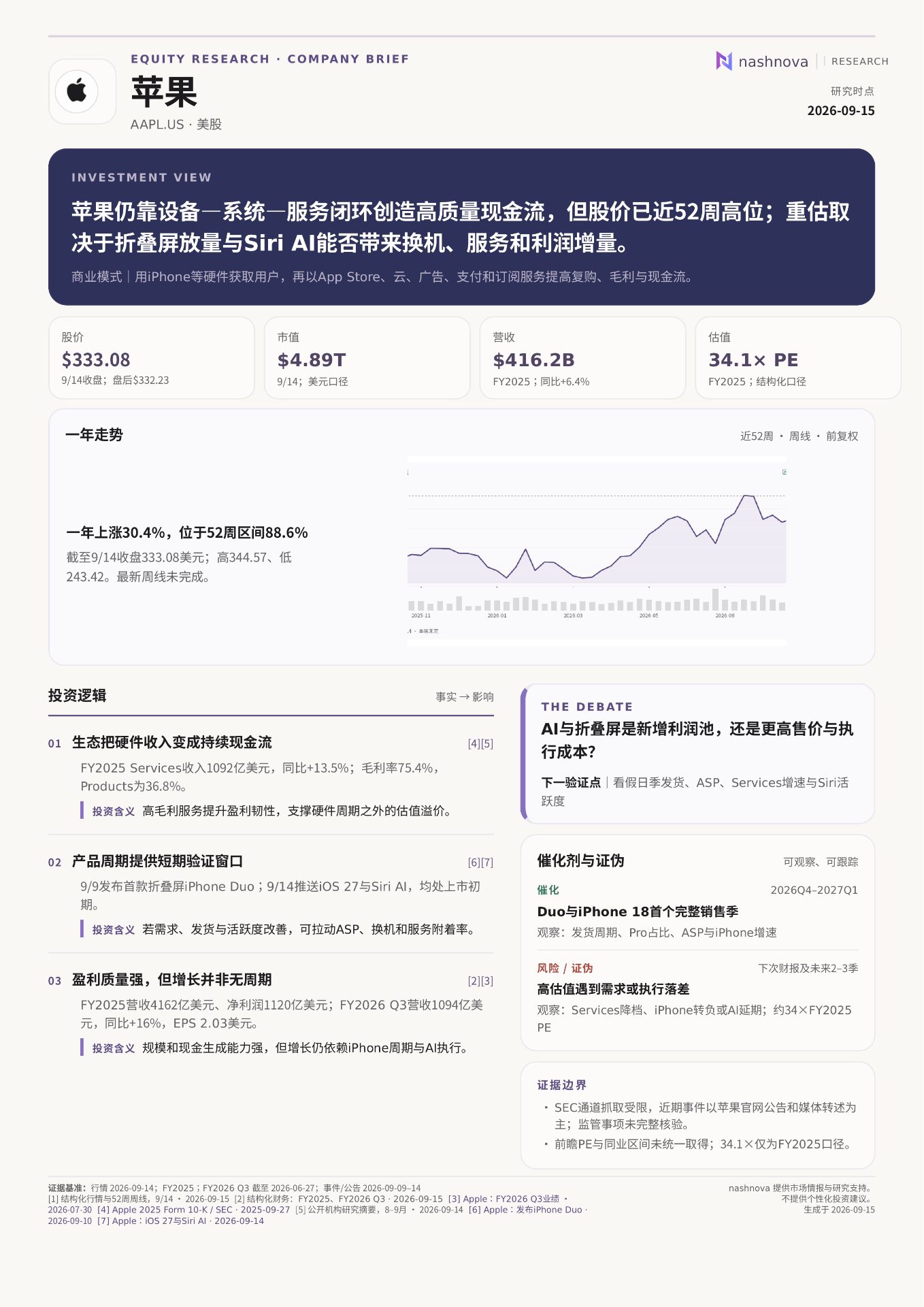
Company Identity and Research Date
The page first states the company name, stock ticker, market, and research date. This section looks simple, but it determines how every subsequent number should be interpreted. Market data, financials, and events all have timestamps, and a one-pager needs to clarify the time boundaries first.
Core Thesis and Business Model
A brief paragraph at the top summarizes the current research theme and supplements it with the company's revenue and cash flow sources. It is not a buy/sell conclusion, but tells the reader: what question the entire page is organized around.
Market Data, Financials, and Valuation Snapshot
Stock price, market cap, annual revenue, and valuation are concentrated in the same area, with corresponding dates or reporting standards retained. A price chart below provides the trailing 52-week trend context, helping readers place the current price within a time frame for observation.
Investment Logic
The page doesn't simply list news items. Instead, it organizes material using a "fact → implication" approach. For example, how the business structure affects cash flow, why a product cycle constitutes a verification window, and to what extent quarterly data supports the current thesis.
Key Debates, Catalysts, and Falsification Conditions
A one-pager doesn't only present material supporting the thesis — it also lists areas of ongoing disagreement separately. Which events are worth continued monitoring and what conditions would weaken the current logic can all be found on the same page.
Sources and Evidence Boundaries
The bottom of the page retains key sources, data standards, and coverage notes. They won't automatically turn a one-pager into a complete research report, but they help readers understand where the information comes from and which conclusions still have room for further verification.
How Is a Company Research One-Pager Different from an AI Chat Summary?
A chat summary is suitable for quickly answering a question. A one-pager is better suited for leaving behind a research starting point that can be reviewed repeatedly.
Comparison Dimension | General Text Summary | Company Research One-Pager |
|---|---|---|
Input Method | Usually requires specifying what content to summarize | Company name plus "one-pager" is enough to start |
Information Retrieval | Depends on the current question and context | Organizes multiple types of evidence based on the company research task |
Content Structure | Varies with each response | Consistently covers thesis, data, logic, risks, and sources |
Timestamps and Standards | May be scattered throughout the text | Explicitly retained as page-level information |
Final Format | A piece of conversation content | Web preview and downloadable A4 PDF |
Subsequent Use | Suitable for immediate reading | More convenient for review, sharing, and continued research |
The key here is not making the content longer, but making the deliverable boundary more explicit. When a user requests a "one-pager," the Agent treats a complete single page as the task endpoint, rather than leaving the formatting and organization work to the user.
What Scenarios Is an AI Company Research One-Pager Suitable For?
A one-pager fits between the start of research and in-depth analysis.
Getting to Know a Company for the First Time
Use a one-pager to first establish a basic map of the business, financials, valuation, events, and risks, then decide which financial report to read in depth or which question to investigate next.
Quick Review After Earnings or Major Events
After a company releases earnings, products, or important announcements, you can regenerate a one-pager to place new data back into the existing research framework, rather than just reading a single news item.
Before Comparing Multiple Companies
When different companies use a similar page structure, differences in business drivers, financial trends, and risks become easier to spot. It can serve as an entry point for comparative research, but does not replace a complete cross-sectional analysis under a unified standard.
Morning Meetings, Discussions, and Personal Research Archiving
A fixed format is easier to review than scattered links and is better suited for quickly syncing background information before a discussion. The PDF can be downloaded directly, and research deliverables can also be kept in the Workspace for continued use.
Ready-to-Copy Company One-Pager Prompts
The most universal version requires no additional structure:
Generate a one-pager for [Company Name / Stock Ticker]
For example:
Generate a one-pager for Microsoft
Generate a one-pager for NVDA
If you have a specific area of focus, you can include the condition in the same sentence:
Generate a one-pager for [Company Name / Stock Ticker], focusing on [business or topic]
For example:
Generate a one-pager for Amazon, focusing on AWS growth and margins.
That's all it takes. Users don't need to copy a long list of field definitions or decide in advance how many columns the page should have. The company and focus area can vary — "one-pager" itself already represents a complete set of research and deliverable requirements.
FAQs About AI Company Analysis and Company One-Pagers
Can AI Generate a Stock Research Report?
Yes. AI can assist in retrieving and organizing market data, financials, earnings calls, company events, and other information, and generate a company research one-pager or a longer stock research report.
Different tools vary in data coverage, source transparency, and output structure. Important facts should still be cross-checked against company filings and regulatory documents.
What Does a Company Research One-Pager Typically Include?
A company research one-pager typically includes company and stock basic information, business model, core financial data, valuation, investment logic, near-term catalysts, key risks, falsification conditions, and information sources. Specific sections may vary depending on the company type and research date.
What Information Is Needed to Use AI for Company Analysis?
At minimum, you only need to provide the company name or stock ticker and indicate that you want a "one-pager."
If you have specific requirements, you can also add the business focus, question, language, or time range in the same sentence, but you don't need to prepare a field list or page template in advance.
Can a Company One-Pager Replace Financial Statements or a Full Valuation Model?
No. A company one-pager is suitable for quickly establishing a research framework, identifying key questions, and organizing follow-up leads. It does not replace original company disclosures, regulatory filings, full valuation models, or the investor's own judgment.
Start AI Company Analysis with One Sentence
Company research is rarely truly just one page, but it can start from one page.
In nashnova, users only need to provide a company name and indicate they want a one-pager. The Agent handles task planning, evidence retrieval, content organization, page generation, and single-page verification in the background, then delivers a result that can be viewed and downloaded directly.
This page will not replace original company disclosures, full valuation models, or the investor's own judgment. It addresses an earlier step: when information is still scattered, it puts the facts, logic, risks, and next verification steps worth paying attention to on the same sheet of paper.
Open nashnova and enter a company you're currently researching:
Generate a one-pager for [Company Name]