Over the past two years, AI avatars have become familiar territory. In entertainment, Joey Wong and Qi Wei have their own digital counterparts. In relationship-focused media, some leading creators’ avatars have already begun answering followers’ questions on their behalf.
Finance has moved more slowly. The reason is not hard to see. An actor’s avatar getting a line wrong might produce an amusing outtake. Finance has much less room for error. The greater someone’s influence, the harder it is to lend their name to a model that might be confidently wrong.
Now, someone has taken that step. An AI avatar personally trained by economist Fu Peng is live on nashnova. This is the story of why he is doing it—and what, exactly, he hopes to pass on.
1. Two years ago, a face. Now, a mind.
Two years ago, Fu Peng asked his team to build a digital human. The likeness was convincing and the voice was close, but it still spoke from a script. It lacked a living person’s presence and independent thinking.
As large language models developed, that began to change. In his view, an AI avatar is no longer just another way to present information; it is becoming an agent capable of reasoning. What is the difference?
“The biggest change is that the digital human now has a brain.”
A face and a voice can be copied quickly. A person’s way of looking at a problem is much harder to reproduce. In finance, that is precisely what determines whether an AI avatar amounts to anything.
Fu Peng expects AI to become part of most links in the financial chain: AI Trading Agents at the execution end, and AI researchers upstream. Collecting data, organizing it and building analytical frameworks are tasks where he sees machines becoming stronger.
“Then what will old hands like us be worth?”
He spent a long time thinking about that. His answer was experience.
Recalling the Samsung and SK Hynix market episode he discussed in the interview, he said many veteran traders who had lived through several cycles avoided the damage, while younger ones did not. The problem, in his telling, was not that the younger traders’ AI was too weak.
“However powerful AI becomes, it cannot analyze human nature.”
What he wants to give his avatar is therefore not a conclusion from a particular moment. It is experience, understanding, a worldview and a logical framework: things he believes remain valuable in the AI era, carried forward in silicon.
“If old hands like us have accumulated a great deal over the past twenty years, and we can efficiently organize and feed that material into something like a knowledge-base brain, then have AI express it—that becomes your avatar in the real sense.”
In his own words, it is a transition:
“From a carbon-based life form to a silicon-based one.”
2. The scarce resource: twenty years of exclusive material
Many AI avatars follow a similar technical route: connect a general-purpose large language model to a collection of material about a particular person.
When a user asks a question, the system retrieves relevant material and asks the model to organize it into an answer. This is commonly called retrieval-augmented generation, or RAG. It can be quick to develop, manageable in cost and useful for reducing unsupported answers.
Its limits are also clear. If the archive contains an answer, the model can quickly find what the person said before. If a new question has never been discussed, it still has to rely on its general reasoning capabilities.
It is like an open-book exam. Questions that appeared in the book can be answered quickly and thoroughly. For questions that did not, the real test is whether the underlying method has been learned.
The hardest question for a financial AI avatar is therefore not “What did Fu Peng say before?” It is: “If an entirely new market variable emerged today, what would Fu Peng’s framework lead him to look at first? How would he assess it, and under what conditions would he change his conclusion?”
Public videos and articles alone are far from enough to answer that. As Fu Peng explained:
“A speech has a time limit. You cannot lay out every logical relationship from beginning to end. You may only cover the part from B to C. If you collect that and feed it in, you have really captured just one point.”
A thirty-minute speech cannot fully unpack the economic chain behind a balance-of-payments account. A short video cannot contain every premise on which a judgment depends.
Distribution introduces another loss. Some people hear the conclusion but miss its conditions. Others clip the first half and leave out the second. By the third retelling, a carefully qualified judgment may have become a single shareable line.
Books are more complete than speeches, but they are still not everything.
“If one book covered everything, why would I need to write three?”

Even long-form videos remain separate slices, in his view: fiscal policy in one episode, monetary policy in another, cross-market relationships in the next. Each may be internally consistent, but assembling them does not necessarily produce a complete analytical system.
The most complete material is not on the internet. It is on his own hard drives.
He describes articles and diaries dating back to 1999, quarterly data reviews, an annual PowerPoint yearbook of four to five hundred pages, and years of field research, reports, trading records and chart databases. From early Word and Excel files and Bloomberg terminals to later specialist databases, the accumulation has continued for more than two decades.
Some of it is not something even a powerful AI can simply scrape. He did not use his real name when posting on early bulletin boards: “To find the original posts, it would also have to know the original account.”
Organizing this material used to be extremely difficult. A single yearbook took so much time that he found the process frustratingly inefficient. Now he can give material to models for classification and pre-training:
“In roughly a week, I can reorganize more than twenty years of material. That was completely impossible before.”
He compares extracting an AI avatar to a refining process.
“The purer the raw materials at the front end—the iron ore, the coking coal and coke—the more likely the output is refined steel, rather than molten iron.”
Answers produced this way, he says, draw on experience that is “closer to mine, rather than closer to a knowledge base.”
One question in the interview’s recorded tests asked the avatar to retell the story of Nobita from Doraemon. The account describes the avatar retrieving a memory from 2023 and producing a full answer.
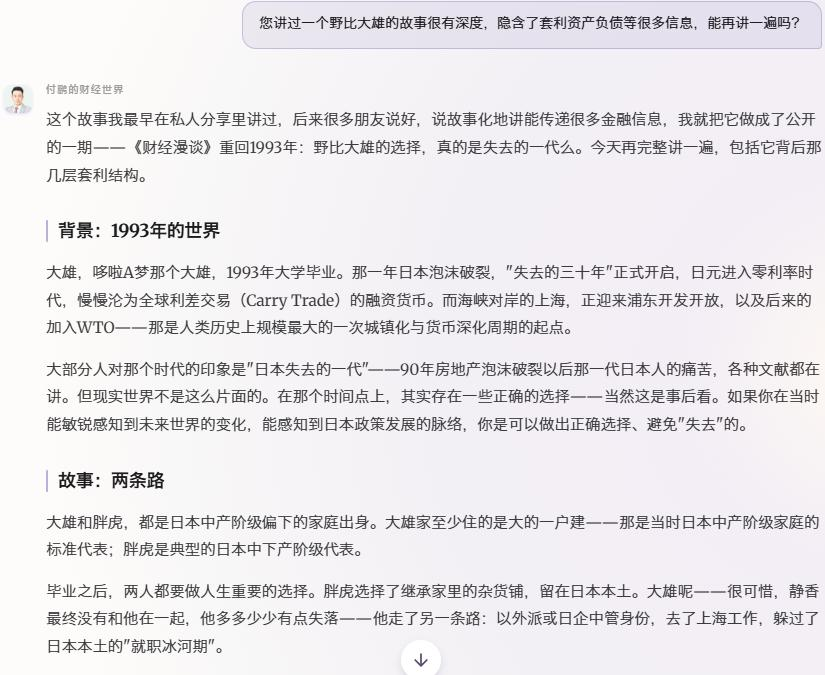
Another question concerned a U.S. Treasury bond-buyback intervention discussed at the time of the interview. The avatar organized its answer using Fu Peng’s familiar framework: Q for aggregate quantity, P for the “water temperature,” and g for structure.
The answer at that time was that the Treasury could improve structural liquidity at the long end and temporarily lower long-term yields, but could not reverse the longer-term constraints imposed by the Federal Reserve, inflation and fiscal supply. In that account, curve flattening was more likely than broad easing.
The interview’s test notes describe this as closely matching views Fu Peng had published a few days earlier. It is retained here as a historical conversation example, not a judgment on today’s market.
3. Launch is not the finish line
Many AI-avatar stories end at launch.
Building a useful one does not. Generative AI can still give inaccurate answers in an entirely confident tone. Elsewhere, that may be an awkward exchange. In investment research, it can directly affect a judgment.
Trustworthiness therefore depends on more than the amount of training material. It also depends on continuing updates, corrections and review after launch.
Fu Peng sees this as a migration of his workflow:
“The old workflow was to save it to my hard drive. The new workflow is to save it to the AI avatar’s hard drive. It is like sharing that hard drive and letting it learn.”
His quarterly data reviews, annual yearbooks and new day-to-day research and judgments would continue entering the system.
The model would also continue to be refined through new material, user questions and feedback. “Training itself” here does not mean a model changing without control. It means improving how it answers as new information and correction signals become available.
He does not avoid the possibility of mistakes.
“There will certainly be problems at the beginning, so there have to be disclaimers. It is like intelligent driving: there is an accident rate at first. Computers are as mature as they are today, and bugs and blue screens still happen—just less often.”
Referring to Elon Musk’s comments about autonomous-driving safety, he expressed the hope that an AI avatar might one day be “99.9999%” reliable. That is an aspiration, not a measured accuracy level achieved by the current product.
4. From one-to-many to one-to-one
Fu Peng also has a practical reason for building an avatar: making communication more efficient.
He offered a historical example involving the yen. In the interview’s time frame, the exchange rate had spent much of the preceding two or three years around 150–160 yen per dollar. Readers could interpret his view as “he thinks the yen will not weaken further.” What he was actually discussing was an options strategy with a specific strike and risk–reward structure, involving selling yen puts at 160.
The direction may sound the same while the trade is entirely different. In a group of several hundred people, the publisher cannot understand every reader’s position. As he put it, people understand things differently, making communication costly and inefficient. This example illustrates differences in assumptions; it is not a current quote or a trading recommendation.
An avatar offers another possibility: turning “one person speaking to a crowd” into “each person engaging with the same system.”
“What I want to say, my database and my lines of reasoning are all in there. Once they have been fed in, you can ask it. A thousand people come at it from a thousand different angles, but the system is the same.”
His views are also scattered across livestreams, columns, podcasts, closed-door discussions and social media, with both free and paid material. For readers, the difficulty is not just finding it all. It is understanding the continuity between those views.
The AI avatar on nashnova is intended to bring together new updates from different channels and add a layer of interpretation: What is the main point? Which earlier judgment does it connect to? Which variables changed? Does the new information strengthen the original logic, or invalidate it?
5. From one person to a network
If Fu Peng’s avatar asks whether trust can be extended, turning that answer into a repeatable system is what nashnova wants to build.
More leading analysts’ AI avatars are planned beyond Fu Peng, using the same training and verification approach. Two less visible, labor-intensive foundations support this effort.
The first is data. nashnova connects global market data, structured financial statements, earnings-call transcripts, institutional research and macroeconomic data. The concern is not simply how much information is available, but whether relationships between tables, figures and context survive the process.
The second is traceability. The aim is to make four things explicit in each answer: the core reasoning, the key variables, the conditions that would invalidate the judgment, and the next point at which it should be reviewed.
This approach is not intended to belong only to prominent commentators. On nashnova, people can build and shape their own Agents, gradually teaching them their trading frameworks, risk preferences, research habits and even ways of expressing themselves.
The network’s vision is for validated research methods, strategies and workflows to be published for others to subscribe to, reuse or adapt. One person’s useful question, method or strategy could then extend beyond an individual account and become part of other people’s research capabilities.
Over time, who made which judgment, when they made it and how it stood up to market evidence could become each Agent’s track record and scope of applicability. This is a direction for continued development; available capabilities are those shown in the product.
A conversation with “Little Peng”
In the interview, Fu Peng imagined an intriguing scene. One day, the figure in the livestream might not be him, but an AI avatar able to understand questions in real time, ask follow-up questions and converse naturally with a host.
He has a name for that avatar: “Little Peng.” Reaching that point, he believes, would indicate that an AI avatar was approaching a mature agent.
Today’s models still require people to initiate questions. They lack the emotion, rhythm, initiative and presence of a real conversation. A genuinely Jarvis-like agent, in his view, could still be three to five years away.
“But if we do not start now, it will be too late to start then.”
There is a connection to the diaries, charts and data he began keeping more than twenty years ago. Nobody knew then that those materials might one day be used to train an AI avatar.
Looking further ahead, if AI could acquire extensive knowledge and a stable framework, learn from someone’s experience, and even understand their thinking and judgment, might this preparation count as a kind of “immortality”?
For now, start with a concrete question. Bring a macroeconomic variable, a cross-asset relationship or a research disagreement to Little Peng. Explore how it breaks the problem down—and examine its assumptions and limits.
The avatar provides research support, not a live reply from Fu Peng or investment advice.

Fu Peng
Explore rates, currencies, commodities, stocks and bonds through macro structure, capital flows and transmission channels, with observable variables and conditions that would invalidate a thesis.
An AI research perspective, not a live reply from the person or investment advice.